
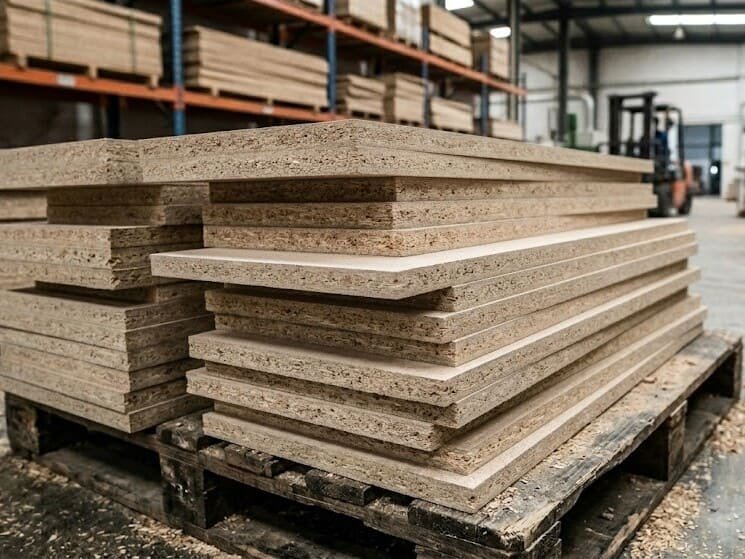
9mm, 12mm, 16mm, 18mm, 25mm
Melamine finish, PET finish, decorative paper finish, HPL laminate, UV finish
Wardrobe carcasses, bookcases, TV cabinets, office cabinets, storage cabinets, dry-area cabinets, standardized panel furniture and custom furniture projects that require cost control and batch production efficiency.
Not recommended for main structures of bathroom vanities, sink cabinets, long-term humid areas, outdoor cabinets or positions close to water-leaking walls. If particle board must be used in these areas, stronger edge sealing and moisture protection are required, and long-term contact with standing water or poorly ventilated high-humidity environments should be avoided.
Flat surface, suitable for large-area finish lamination, easier cost control and stable board dimensions. It is suitable for standardized production and batch delivery of cabinet projects.
Moisture resistance is limited. Edges may swell after water penetration. Screw-holding strength is generally lower than plywood, and repeated disassembly may loosen the fixing holes. It is not ideal for high-load structures or positions that require frequent disassembly.
Check whether the board density is even, whether the edges are loose, whether the edge sealing is firm, whether drilling accuracy is stable, and whether hardware fixing holes are accurately processed and securely positioned to reduce the risk of loosening, water penetration or deformation during long-term use.
Share your drawings, dimensions, reference images, or project requirements. Our team can help suggest suitable material options before production.