

PET and PVC thermofoil are both polymer-based finishes. So when people first see them, it is easy to think of them as two similar “plastic finishes.” But in actual production, they use different processing methods.
In our previous articles, we already explained the structure of PET cabinet doors and the production process of PVC thermofoil doors. This article will not repeat those basics. Instead, we will compare the two production routes and look at how they affect door styles, edges, substrates, cost, and how buyers should compare the two options.
One point should be clear first. Most of our factory experience is with flat-laminated PET. So the discussion below does not include PETG or other materials used for some 3D forming applications.
The Main Difference: Pre-Laminated Panels vs Thermoforming
| Comparison | Flat-Laminated PET Cabinet Doors | PVC Thermofoil Cabinet Doors |
|---|---|---|
| How the finish is applied | PET is laminated onto a flat panel first, then the panel is cut to size and edge banded | MDF is shaped first, then PVC film is thermoformed over it |
| Common door styles | Commonly used for slab doors | Can be used for slab doors, but is more suitable for Shaker doors, recessed profiles, CNC-routed designs, and some curved shapes |
| Common substrates | MDF is the most common, but plywood, particleboard, OSB, and other suitable panels can also be used | Usually MDF that is suitable for CNC shaping |
| Edge construction | Separate edge banding | PVC film usually wraps continuously from the front over all four edges |
| Back surface | Can be PET or another back material | Usually uses a separate back finish |
Simply put, the flat-laminated PET route discussed here usually starts with a pre-laminated panel. It is more like a panel construction made up of the surface finish, substrate, back surface, and edge banding.
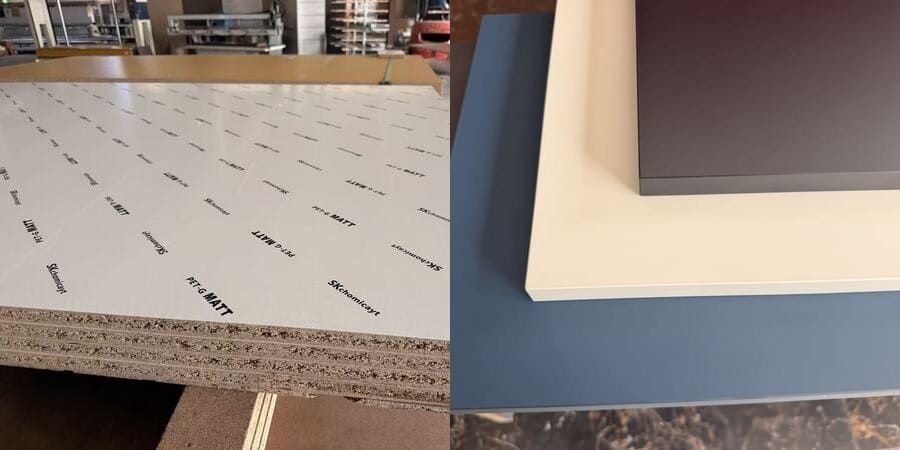
PVC thermofoil depends more on MDF shaping and the later thermoforming process.
What Are the Pros and Cons of PET and PVC Thermofoil?
If we only list a few advantages and disadvantages, it is easy to turn this into a simple material comparison. But a cabinet door is more than just its surface finish.
In actual applications, I think it makes more sense to compare door style, edges, construction, and cost.
Door style: slab doors and shaped doors follow different production routes
PET is usually already laminated onto a flat panel. The later steps are mainly cutting and edge banding. This makes it suitable for minimalist slab doors and large matte or high-gloss flat surfaces.
The main advantage of PVC thermofoil is its ability to work with shaped door profiles.
MDF can first be machined into Shaker doors, recessed grooves, curves, or other CNC-routed shapes. The PVC film is then formed over the surface.
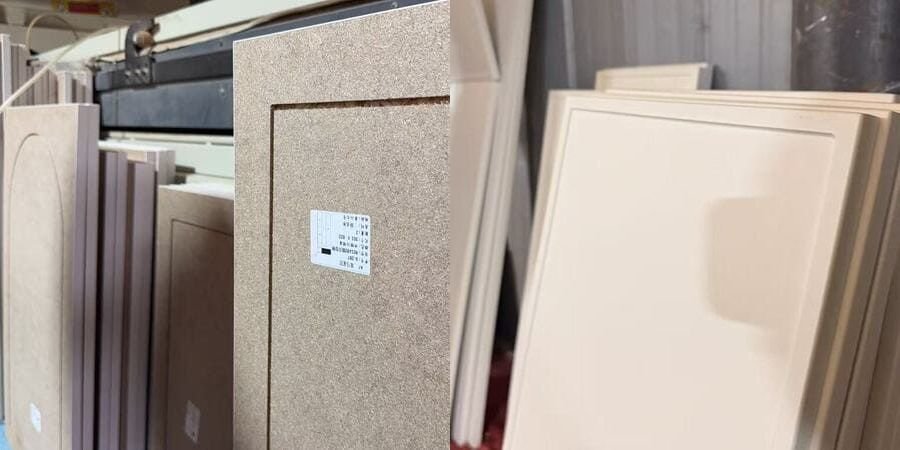
So when the cabinet door is not simply flat, PVC thermofoil usually offers more design flexibility.
However, the more complex the shape is, the more demanding the thermoforming process becomes. Deep grooves, narrow grooves, inside corners, and sharp transitions all need to be checked carefully to make sure they can be formed consistently.
Edges: separate edge banding and continuous wrapping look different
PET cabinet doors need separate edge banding.
This means that, besides the PET finish on the front, the edge banding color, gloss, thickness, glue line, and corner finishing also need to be confirmed.
When the work is done well, the edge banding can look very close to the front surface. But structurally, the PET surface and the edge banding are still two separate materials.
For PET doors we have actually processed, we have used both 0.3 mm and 0.5 mm PET. The construction included plywood or MDF, PET on both sides, 1 mm PVC edge banding, and PUR edge banding.
This is only a configuration we have actually used. It is not a standard structure for all PET cabinet doors. ABS edge banding can also be selected, depending on the project requirements.
PVC thermofoil usually uses one film that extends continuously from the front surface over all four edges.
This gives the front and edges a more continuous appearance. It does not have the same visible material transition found with separate edge banding.
However, this continuous finish also depends on good thermoforming quality. If the door has deep grooves, inside corners, or sharp transitions, these areas need to be checked carefully.
For example, the film should be checked for excessive stretching, whitening, incomplete bonding, or tearing.
Substrates and back surfaces: flat-laminated PET allows more construction options
Flat-laminated PET doors can be made with different construction combinations.
MDF is still the most common and usually the preferred substrate. But plywood, particleboard, OSB, and other suitable panels can also be used depending on the product positioning.
The back surface can also be adjusted. For example, the door can use PET on both sides, or PET on the front with melamine-impregnated paper on the back.
Recently, I visited a PET processing factory to learn more about their actual production. I saw products using particleboard and OSB as substrates. We have not used these two substrates for PET doors in our own factory yet.
I also saw panels with PET on the front and melamine-impregnated paper on the back. After talking with the person in charge of the factory, I learned that one main reason for using this construction is to reduce cost.
This flexibility allows suppliers to adjust the construction based on budget, product positioning, and application requirements.
But it can also create confusion during quotation. If a quotation only says “PET cabinet door” without specifying the substrate and back construction, two suppliers may not actually be quoting the same product.
PVC thermofoil doors are more commonly based on MDF. MDF has a relatively uniform structure, and the routed surface is easier to sand and prepare for later processing. This is why MDF is commonly used for shaped thermofoil doors.
Cost: do not compare only the “PET price” and the “PVC price”
I would not say that PET is always more expensive than PVC thermofoil. I would also not say that PVC thermofoil is always cheaper.
The cost of a PET cabinet door can be affected by the substrate, PET product series, whether PET is used on both sides, the back material, panel thickness, and edge-banding specification.
For example, an MDF door with PET on both sides and a particleboard door with PET on the front and melamine on the back may both be described as “PET cabinet doors.”
But their construction and cost can be different.
For PVC thermofoil doors, cost is more often affected by the MDF specification, PVC film, door thickness, complexity of the CNC profile, and difficulty of the thermoforming process.
So before comparing prices, the full construction should be confirmed first.
Surface finish: both materials are available in more than one look
Both PET and PVC thermofoil can be supplied in matte, high-gloss, and different colors and textures.
Anti-fingerprint PET surfaces are also common. But anti-fingerprint performance belongs to a specific product or surface system. It does not mean that every PET cabinet door has anti-fingerprint performance.
If a project clearly requires an anti-fingerprint surface, the exact product and physical sample should still be confirmed.
Heat, scratch, moisture, and environmental performance cannot be judged by the material name alone
These points often appear in PET and PVC comparison articles. But I would not judge one material as automatically better based only on the names “PET” or “PVC.”
Different performance areas depend on different factors.1
Scratch resistance depends more on the specific film and surface coating.
Heat resistance also needs to be considered together with the film, adhesive system, and where the door will be used.
Moisture resistance depends on the complete cabinet door construction, including the front surface, edges, back surface, holes, and internal substrate.
For example, PVC thermofoil can provide continuous coverage across the front and four edges. But this does not mean the whole cabinet door is completely waterproof.
With PET doors, the quality of the edge banding and the edge construction can also affect performance in humid conditions.
The same principle applies when comparing environmental impact. Without specific material information, life-cycle assessment data, or other comparable environmental information, I would not simply say that PET or PVC is always the more environmentally friendly option.
If a project has clear requirements for heat resistance, scratch resistance, moisture resistance, or environmental performance, I would prefer to check the technical data sheet and other relevant documents for the specific product instead of making a decision based only on whether it is PET or PVC.
How Do I Decide Between PET and PVC Thermofoil for a Client?
When a client asks whether they should choose PET or PVC thermofoil, I usually do not start by saying that one is better.
I first confirm a few questions: What is the cabinet door style? What surface effect is required? Are there any special requirements for the substrate or back construction? Where will the door be used?
If the project needs minimalist slab doors, large matte or high-gloss flat surfaces, and more flexibility in substrate and back construction, flat-laminated PET is usually worth considering first.
If the project needs Shaker doors, CNC-routed profiles, recessed designs, or curved shapes, PVC thermofoil is usually more suitable.
It also works well when the finish needs to continue from the front surface around the edges.
If the cabinet door is close to a continuous heat source, or if the project has specific requirements for scratch resistance or moisture resistance, I would not make the decision based only on whether the material is PET or PVC.
I would continue checking the specific product information, actual use conditions, and samples.
This is about matching the construction to the application, not deciding which material is more premium.
What Should Buyers Confirm Before Comparing Quotations and Approving Samples?
If the two options have already reached the quotation or sampling stage, there are four things that should be confirmed:
-
Is the door style suitable for the production route? A slab door and a complex shaped door may naturally require different processing methods.
-
Are the two quotations based on comparable constructions? If the substrate, back surface, panel thickness, or edge construction is different, the prices are not directly comparable even if the product names are the same.
-
How are the edges and back surface made? PET requires separate confirmation of the edge-banding material, as well as the front and back materials. PVC thermofoil does not need separate edge banding on all four sides in the same way, but the PVC film, back material, and actual forming result of complex door profiles still need to be confirmed. These differences can directly affect appearance, construction, and cost.
-
Confirm a complete finished door sample together with the corresponding specifications. A PET color sample or a small PVC film sample only shows part of the surface. It does not represent the finished cabinet door. If a PVC thermofoil project includes complex door styles, the sample should also show the key profile used in the actual project.
Final Notes
The difference between PET and PVC thermofoil is not only the difference between two plastic materials.
The two production methods suit different door styles and also create different edge effects, cost variables, and sample-approval points.
For a custom cabinetry project, I prefer to first look at the door style, target surface, where the door will be used, and the structural requirements. Then I decide which production route is more suitable.
After that, the final solution can be confirmed with a complete finished door sample and the corresponding specifications.
If a client has not yet decided between PET and PVC thermofoil, Horace Home usually compares the two options in this order before deciding which construction should be confirmed and sampled next.
Based on research published in *Coatings*, *Evaluation of Resistance Properties of Selected Surface Treatments on Medium Density Fibreboards*. ↩