

Over the past two years, fewer of the customers we have worked with have chosen thermoplastic film finishes for their cabinetry. I think one possible reason is that customers' budget choices are becoming more divided. Customers with a limited budget often choose melamine finishes directly, while customers with a higher budget are more likely to choose natural wood veneer or painted finishes. In the projects we have recently worked on, thermoplastic film finishes often sit between these two choices. With price competition also becoming stronger, we have seen much less demand for this type of finish than before.
However, I do not think thermoplastic film finishes always mean cheap or low-end. One customer once invited us to visit his home and showed us a full set of furniture finished with PVC film. The color was very consistent, and the wrapping around the doors, corners, and other details was carefully done. The whole set of furniture looked very consistent as a whole. More interestingly, the customer told us that the final cost was not lower than natural wood veneer.
So I think the more useful question is not whether PVC wrapping is “low-end.” It is how this type of door is actually made, and how the substrate, door profile, film, and membrane-pressing process affect the final result. That is what we will discuss in this article.
What Does “Thermofoil Cabinets” Actually Mean?
Thermoplastic film finishes are often used on visible parts such as cabinet doors and drawer fronts. The cabinet box itself may still use melamine-faced panels or other materials. If the customer wants the cabinet doors and visible cabinet panels to have a more consistent finish, exposed side panels and end panels can also use matching wrapped finishes.
For the products we usually make, we use MDF as the substrate. After the profile is machined, PVC film is applied through vacuum membrane pressing.1 In our factory, we usually call this PVC vacuum forming or PVC membrane pressing.
I also checked how this type of product is described in different markets. There is no single name used everywhere. In North America, Thermofoil is more common. In the UK, Vinyl Wrapped or Foil Wrapped is often used. In Australia and New Zealand, Vinyl Wrap or Thermoform is common. In India and some Southeast Asian markets, PVC Membrane or Membrane Door is more commonly used.
These terms overlap, but they do not always mean exactly the same film material or manufacturing process. In this article, we mainly discuss the MDF + PVC membrane system that we work with in our own projects.
What Is the Typical Structure of a PVC / Thermofoil Cabinet Door?
The structure of the doors we normally work with is not very complicated. MDF is used as the substrate. PVC film continuously covers the front face and the four side edges, while the back is finished separately.
So the basic structure can be understood as:
MDF substrate + continuous PVC film on the front and four edges + separate back finish
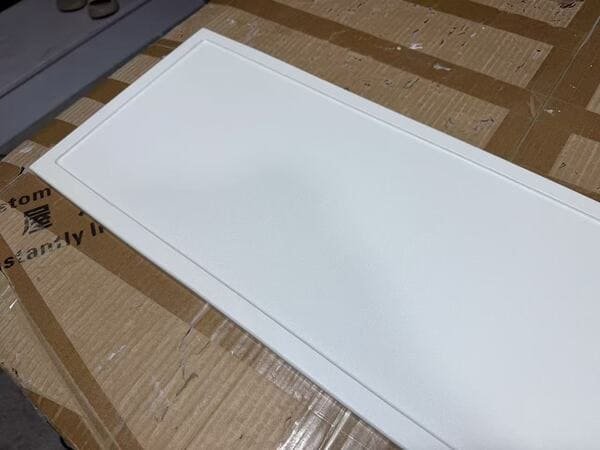
For the products we commonly see, the back is often finished with melamine. Some products also use a matching wrapped finish on the back. The exact construction depends on the product.
This small detail is important in real projects. Some customers may assume that because the front and four edges are continuously wrapped, the whole door is completely sealed and therefore waterproof.
PVC film can provide a continuous surface over the front and edges, but the back, drilled holes, hardware fixing holes, and later cut areas may still expose the substrate or other surface materials. So a door should not automatically be considered waterproof just because the front and four edges are continuously wrapped.
How Are PVC Vacuum-Formed Cabinet Doors Made?
The MDF substrate is normally processed in our own factory. We first select the required MDF thickness according to the drawings, then complete CNC routing, profiling, and sanding. Our common cabinet door thicknesses are mainly 22 mm and 25 mm, although other thicknesses may also be used for special products.
For profiled doors, sanding is an important step. Grooves, corners, and routed edges need to be kept as smooth as possible. The PVC film will follow the MDF surface during forming, so visible tool marks, rough fibers, or uneven areas in the substrate may become even more noticeable after wrapping.2
After the substrate is ready, we send the parts to a specialized membrane-pressing factory. Adhesive application, PVC film preparation, heating, and vacuum membrane pressing are all completed by this specialist partner rather than inside our own factory.
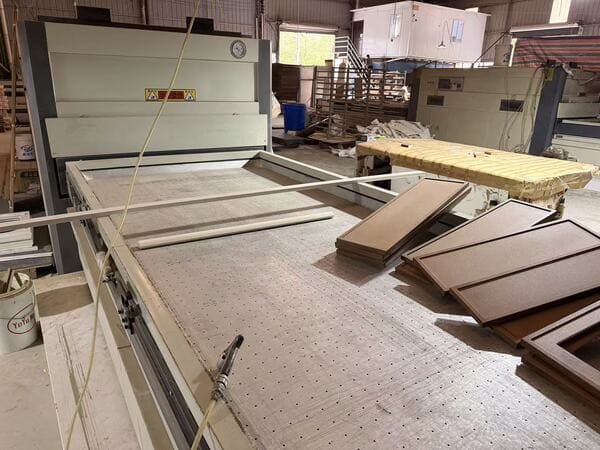
The process is not simply about pulling PVC film onto the MDF with vacuum. Before pressing, the film needs to be preheated so that the PVC becomes softer. At the same time, the adhesive also needs enough heat to reactivate and bond properly. Vacuum, positive pressure, temperature, and time all need to work together.3
To better understand the actual parameters, I recently asked our membrane-pressing partner about the settings they currently use.
For flat panels, their positive forming pressure is usually around 7–8 bar. For profiled panels, it is normally around 9 bar, and some more complex profiles may use slightly higher pressure.
According to the verbal reference they gave us, the panels normally go through more than 30 seconds of preheating before pressing. The equipment temperature setting during the preheating stage is above 100°C, and the complete membrane-pressing cycle usually takes around 2–3 minutes.
However, the membrane factory also stressed that these are not fixed settings. Panel size, profile design, film type, and the actual machine can all affect the required temperature, time, and pressure. These numbers only represent the current reference settings used by our partner. They should not be treated as a universal standard for all PVC membrane pressing.
I also asked them about the adhesive they use. The membrane factory simply calls it “vacuum forming adhesive,” but they did not provide a specific brand or product model.
I checked some professional adhesive information and found that polyurethane dispersion adhesive (PUD) is commonly used for 3D membrane pressing of thermoplastic furniture films onto MDF.4 However, because we have not confirmed the exact adhesive used by our membrane-pressing partner, I will not assume its specific chemical system here.
After pressing, the parts are sent back to our factory. We then check the surface, edges, corners, and profiled areas for proper adhesion. Simple profiles are usually easier to inspect. For more complex shapes, we pay more attention to areas where the film may not have fully formed, where bubbling may appear, or where other local defects may occur.
Why Does the Door Profile Affect PVC Wrapping Quality?
PVC film has a certain amount of elongation. After heating, it can stretch and follow the shape of the MDF surface. This allows it to cover flat areas, curves, grooves, and some more complex door profiles.
But not every profile is equally easy to form.
Flat surfaces and gentle curves are usually easier. Deep grooves, narrow grooves, concave corners, and sharp transitions are more difficult.
In these areas, the PVC film needs to stretch more. At the same time, air removal and full contact inside deep or narrow areas also become more difficult.
If a groove is too deep, too narrow, or has a sharp transition, the vacuum may not work fully in that local area, and the PVC film may not completely reach the bottom of the profile. On the other hand, if the film stretches too much in one area, it can become thinner. Sharp corners may also increase the risk of local damage.
So when we look at a PVC vacuum-formed door, we do not only consider whether the profile looks good. We also consider whether the profile is suitable for membrane pressing. The thermoformability and thickness of the film, together with groove depth, corner radius, and profile transitions, all need to work together.
We Once Found Incomplete Adhesion in a Deep Narrow Groove
We encountered this type of profile limitation in a real project.
A batch of skirting boards and wall decorative moldings used MDF with PVC wrapping. These were not simple flat parts. They included curves, concave areas, and relatively deep narrow grooves. We completed the CNC profiling and sanding in our factory, then sent the parts to the specialist membrane factory for PVC wrapping.
After the finished parts came back to our factory, we found during inspection that some concave and deep groove areas had not fully bonded. The other surfaces looked normal, but in these narrow and deep areas, it was still possible to see that the PVC film had not fully contacted the MDF underneath.
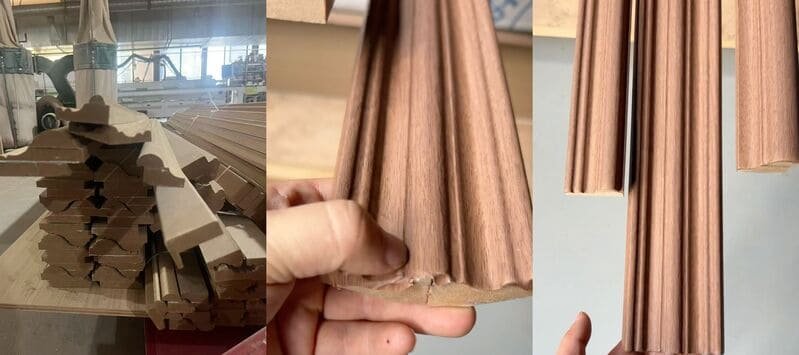
We later checked the issue together with the membrane factory. They told us that these areas were too deep and too narrow in some places. Air was not completely removed during vacuum forming, so the PVC film did not fully enter the bottom of the groove and bond to the substrate.
The affected parts were sent back for rework.
I still remember this case quite clearly. From the front, the molding profile did not look extremely complicated. But once it went through membrane pressing, the depth, width, and corner transitions of the concave areas clearly affected the actual forming result.
For this type of complex profile, we now pay more attention to the actual result of a sample or first article instead of deciding only from the drawing whether the design can be produced.
Is Thicker PVC Film Always Better? Forming Performance Also Matters
The PVC films we commonly work with are roughly 0.15–0.35 mm thick. The actual thickness used can vary depending on the door style and profile.
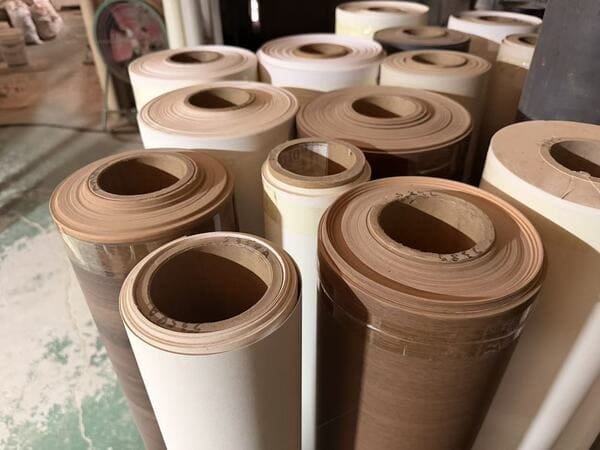
From our experience, when a door has strong corners, sharp transitions, or locally sharp edges, we may prefer a slightly thicker PVC film. This is mainly because the film stretches in these areas. If it is too thin, it may become very thin locally or even be damaged.
However, thicker PVC film is not always better. For the deep and narrow grooves mentioned above, a thicker film can also be more difficult to form closely into the profile under vacuum.
I also asked the membrane factory how they judge whether a PVC film is suitable for a certain profile.
They told me that, among the PVC films they currently work with, many suppliers do not provide complete data for maximum heat resistance or elongation. Instead, suppliers often describe their products with terms such as “heat resistant” or “high elongation.” So for the membrane factory, actual trial pressing is often the most practical way to see how the film performs.
They pay particular attention to corners. If the PVC film becomes visibly white after stretching, or becomes very thin at an outside corner, or even breaks in severe cases, it usually means that the film, profile, and forming conditions are not working well together.
If the film and forming conditions are suitable for the profile, these areas are less likely to show obvious whitening, excessive thinning, or damage.
However, this does not mean that whitening at a corner always means the PVC film is poor quality. Temperature, pressure, corner radius, stretching level, and the profile itself can all affect the final result.
So when we evaluate a PVC film, we do not look only at thickness. We consider the film, thickness, door profile, and actual trial-pressing result together.
Are Production-Stage Poor Adhesion and Peeling During Use the Same Problem?
These two problems may both look like the PVC film is separating from the substrate, but they are not the same.
The deep groove problem described above was already present during production. Some local areas had not fully formed or bonded to the MDF when the part came out of the membrane press. This type of problem can usually be found during production inspection or when the finished parts return to our factory.
Another situation is when the product looks normal when first installed, but the PVC film gradually starts to lift, bubble, or separate from the substrate after a period of use. This is usually described as peeling or delamination.
Peeling during use can have more complicated causes. It may be related to long-term heat exposure, steam, moisture entry, adhesive condition, material aging, or physical damage.
So when we see PVC film lifting from the substrate, we cannot immediately decide what caused it.
This is why we first try to separate a production-stage forming or bonding problem from a failure that develops after a period of use. They may look similar, but the troubleshooting direction is different.
What Should Be Confirmed When Purchasing PVC / Thermofoil Cabinet Doors for a Project?
If you only look at a sample or rendering, it is usually easy to confirm the color and door style of a PVC-wrapped cabinet door. But before mass production, several structural and manufacturing details should also be confirmed.
| Item to Confirm | What to Confirm | Why It Matters |
|---|---|---|
| MDF substrate and thickness | Our common cabinet door thicknesses are mainly 22 mm and 25 mm. Other thicknesses can be confirmed according to the door design and project requirements | Thickness affects door weight, available profile depth, and the overall result |
| PVC film | Film type, thickness, color, and surface finish | Complex profiles should not be specified by color alone |
| Door profile | Complex grooves, concave areas, corner radii, and sharp transitions | These areas directly affect forming difficulty |
| Front, edges, and back | Whether the back uses melamine or a matching wrapped finish | Different structures require different door construction |
| Installation location | Whether the door will be close to ovens, steam sources, or areas with long-term heat exposure | The use environment can affect long-term stability |
| Sample and first article | Whether a complex profile should be tested with a sample or first article before production | Drawings cannot fully show the actual membrane-forming result |
| Color and film batch | Whether the same film can still be sourced for mass production or later replacement orders | This helps reduce visible color or surface differences later |
For this type of door, I think one of the most easily overlooked questions is not the color, but whether the profile shown on the drawing can be produced consistently.
For a continuous row of visible cabinet doors, even small differences in profile forming or surface adhesion can become noticeable after installation.
So before mass production, confirming the film, substrate, profile, and sample together is usually more useful than simply asking whether a certain PVC film is “good.”
Final Notes
For PVC-wrapped cabinet doors, I do not think it is necessary to first label the product as high-end or low-end. It is more important to see whether it is suitable for the door profile, installation location, and project requirements.
If a project includes more complex profiles, I prefer to see the actual forming result of a sample before moving into mass production. Many details are not obvious from the drawing alone. We often need to see the actual membrane-pressed sample before we know whether the film and profile are a good match.
If you are developing similar PVC-wrapped cabinet doors or other custom cabinetry, Horace Home can also review the substrate, door profile, and production method with you based on your drawings, and help determine whether this process is suitable for the project.
Based on information from the Composite Panel Association (CPA), *3D & 2D Laminates*. ↩
Based on information from *Materials & Design*, *The Effect of Surface Roughness on Tensile Strength of the Medium Density Fiberboard (MDF) Overlaid with Polyvinyl Chloride (PVC)*. ↩
Based on information from the *Albanian Journal of Agricultural Sciences*, *Study of Pressing Temperature in Membrane Presses*. ↩
Based on information from the *International Journal of Adhesion and Adhesives*, *A Review of Adhesives for Furniture*. ↩