

In the previous articles, we introduced two common types of wood based panel materials: plywood and particleboard. Besides these two materials, MDF is also a common wood based panel used in custom cabinetry and interior woodwork. This article will introduce MDF through its basic structure, main performance, and actual applications.
What Is MDF?
The full English name of MDF is Medium density fibreboard, or MDF for short. It is mainly made from wood fibres. Synthetic resin adhesive and other necessary additives are added. The material is then dried, formed, and hot pressed into panels.
Compared with plywood and particleboard, MDF has finer fibres, a relatively uniform internal structure, and a surface that is usually flat It does not have the natural knots or clear grain direction found in solid wood. For this reason, it is suitable for routing, carving, painting, and other types of machining.
According to the Chinese national standard GB/T 18259—20181, fibreboard can be divided into the following four types by product density:
- Ultra low density fibreboard (ULDF): density below 550 kg/m³;
- Low density fibreboard (LDF): density range of 550 — 650 kg/m³;
- Medium density fibreboard (MDF): density range of 650 — 800 kg/m³;
- High density fibreboard (HDF): density above 800 kg/m³.
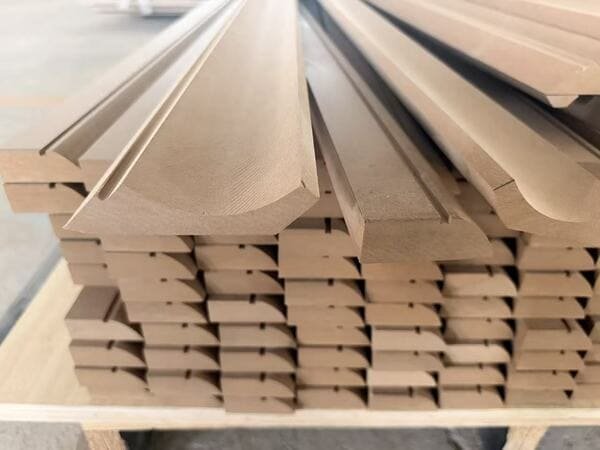
In our production, MDF is used less often for cabinet structures. For cabinet structures, we usually recommend choosing between particleboard and plywood. However, for cabinet doors with more complex shapes and some decorative mouldings, we are more likely to recommend MDF as the base material.
Why Is MDF Commonly Used for Shaped Cabinet Doors and Decorative Mouldings?
MDF does not have the clear layered structure of plywood. It also does not have the larger wood particles found in particleboard. When we make grooves, carvings, or continuous curves, the cutting tool usually gives a relatively consistent cutting result in different directions and positions.
In our production, we usually use medium density fibreboard for these shaped parts, instead of fibreboard with a higher density. With our current equipment, tools, and machining settings, higher panel density increases cutting resistance and tool load during CNC machining. Medium density fibreboard gives us a more suitable balance between machining efficiency, shape quality, and later surface treatment.
For parts with grooves, curves, frames, or several profile levels, MDF makes it easier to produce continuous shapes. It is also easier to sand and paint. However, whether we can get a stable machining result also depends on the internal bond quality, density uniformity, machining depth, and other factors.
What Else Should We Check Besides Density Grade?
First, we need to make one point clear. Density grade only helps us identify the product type. It does not fully represent the actual machining and use performance of the panel.
For the shaped cabinet doors and decorative parts we produce, common MDF surface treatments include paint and PVC membrane. During PVC membrane pressing, we have seen some panels develop uneven surfaces after pressing. After checking the sanding, adhesive application, and pressing settings, we also inspect the fibre condition in the routed areas and judge whether the panel may have local differences in density distribution.
For this reason, besides density grade, we also need to consider performance indicators that are directly related to MDF machining and use.
Internal Bond Strength
A test report gives a specific value. In daily machining, we usually notice problems first from the condition of the cut surface. After MDF has been grooved or carved, a fine cut surface and complete edges usually make later sanding, painting, or PVC membrane pressing easier. If we see clear fibre raising, looseness, powdering, or even local fibre loss, we need to pay attention to the internal bond quality of the panel.
However, these signs can only help us make an initial judgment. Whether the panel meets the internal bond strength requirement still needs to be confirmed according to the required test method and the related product requirements. Examples include China’s GB/T 11718—20212 and Europe’s EN 622-53.
Thickness Swelling and Formaldehyde Emissions
We already introduced thickness swelling after water absorption and formaldehyde emissions in the previous articles about related panel materials. The basic ways to judge them are also similar, so we will not repeat them here.
One point needs special attention with MDF. Grooving or carving removes the denser surface layer and directly exposes the internal fibres. In production, we pay more attention to whether the routed areas, panel edges, and drilled holes are properly sealed. If the paint or PVC membrane treatment is incomplete, moisture can enter more easily through these areas. This may later cause local swelling or deformation.
How We Machine and Observe MDF
How We Usually Machine MDF
Because the internal fibres are directly exposed after routing, we usually inspect the cut surface and move the parts into sanding as soon as possible after machining.
Before sanding, our workers usually touch the cut surface by hand. When the surface is fine and the machining result is stable, it feels relatively smooth. There should not be clear fibre raising, looseness, or powdering. If some areas feel clearly rough, or fibres come loose with light contact, we continue checking whether the problem comes from the panel itself, the tool, or the machining settings. Touch can help us find problems, but it cannot directly replace an internal bond strength test.
After the first sanding stage, if the finish is paint, we first seal the exposed fibres. The parts then move into the later primer and topcoat stages. Sealing cannot make MDF waterproof. However, it can reduce how quickly the fibres absorb coating materials and moisture. It can also make the later painted surface more even.
If the finish is PVC membrane, sanding and dust removal are followed by adhesive application, waiting time, and membrane pressing. We usually arrange these processes as soon as possible. We try not to leave the machined bare panels in storage for a long time because dust, moisture, or surface damage can affect the later membrane finish.
Although these treatments can reduce the moisture risk of MDF, we still do not recommend ordinary MDF for places that stay damp for a long time, may come into contact with standing water, or have direct waterproofing requirements. Even when moisture resistant MDF is used, it still needs to be judged together with the test report, surface sealing, and actual use environment.
Observing the Holes After Removing a Hinge
We used a leftover piece of MDF from the factory for a simple observation. We first installed a hinge normally on the MDF. Then we directly pulled the hinge away from the panel with force. After that, we checked the drilled holes and the material around the screws.
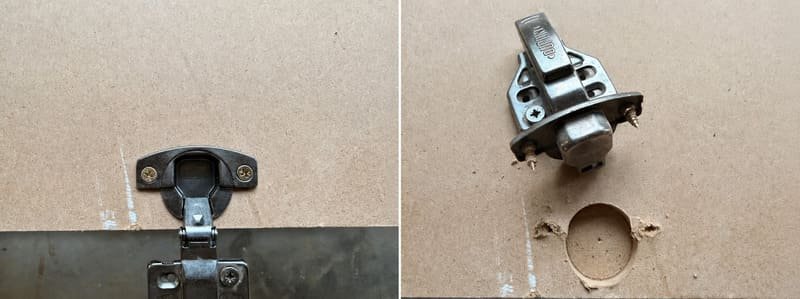
Left 1: The hinge after normal installation.
Left 2: The holes left after removing the hinge. At this point, we can clearly see the wall and bottom of the hinge cup hole, as well as the fibres around the two screw holes.
From the images, the overall shape of the hinge cup hole is still quite complete, and the hole wall also looks quite fine. There are some pulled areas around the two screw holes. These marks were caused when we removed the hinge with force. We cannot judge that the panel has poor internal bond strength based only on these marks.
In this observation, we mainly wanted to see whether the hole wall had clear fibre raising or powdering, whether the damage around the screw holes stayed in a small area or continued to spread into the surrounding area, and whether the internal fibres still looked relatively compact after removal.
We did not record the panel thickness, hinge cup diameter, or actual removal force. This observation is only used to show the fibre condition after drilling and hinge removal. It cannot be used to compare the performance of different MDF panels. It also cannot replace a standard screw holding strength test. It can help us directly observe the condition of MDF after drilling and hardware installation, but the actual performance still needs to be confirmed by test data.
Final Notes
The fine and relatively uniform fibre structure of MDF is its main advantage in shape machining. In our production, when we work with cabinet doors with complex shapes and decorative mouldings, we usually consider MDF first.
However, material selection should not be based only on density grade. Internal bond strength, thickness swelling, formaldehyde emissions, and actual machining performance should also be considered.
In actual use, Horace Home selects the panel according to the shape, surface finish, and use environment. We also properly sand and seal the routed areas and exposed fibres. MDF can show its advantages in grooving, carving, and surface treatment, but it is not suitable for places that stay damp for a long time or may contact standing water.
Based on Chinese national standard GB/T 18259—2018, *Terms of Wood-Based Panels and Their Surface Decoration*, for the density classification of fibreboard. ↩
Based on Chinese national standard GB/T 11718—2021, *Medium Density Fibreboard*, for MDF performance requirements and testing methods. ↩
Based on European standard EN 622-5, *Fibreboards – Specifications – Part 5: Requirements for Dry Process Boards (MDF)*, for relevant MDF performance requirements. ↩