

Particleboard is a common substrate used in custom cabinetry. However, simply specifying “particleboard” is usually not enough to define a complete material specification during procurement. Even when two panels are both classified as particleboard, they may perform differently in terms of internal structure, moisture stability, cutting, and edge banding.
This article explains several performance indicators that deserve more attention from the perspective of cabinet production and procurement. It also distinguishes between problems that can be identified during incoming inspection and processing, and properties that must still be confirmed through product specifications or test reports.
What Is Particleboard, and Why Is It Used in Cabinets?
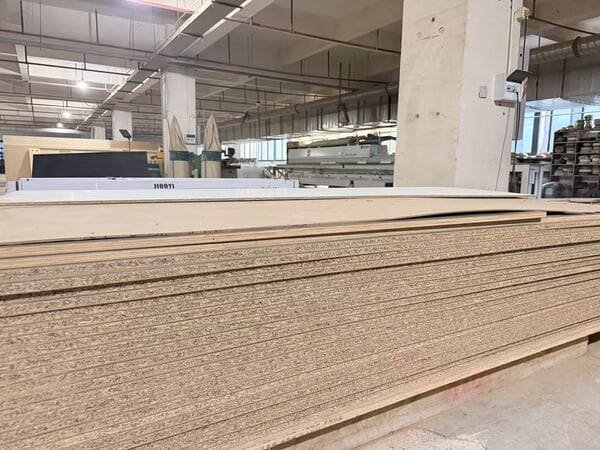
The material is generally called particleboard in English, although chipboard is also used in some markets. Particleboard is made mainly from wood particles combined with synthetic resin or other adhesives. The production process normally includes drying, adhesive application, forming, and hot pressing. Some of the raw material may come from wood-processing residues, helping make better use of wood resources.
Common particleboard has a graded structure. The particles in the core are relatively coarse, while those near the upper and lower surfaces are finer. The core forms most of the panel thickness, while the finer surface layers help create a smooth face for subsequent decorative finishing.
Cost is not the only reason particleboard is used in cabinetry. Its surface is relatively flat, it is suitable for CNC processing, and it can be finished in a wide range of colours and textures. In suitable environments, it can be used for wardrobes, storage cabinets, and other interior cabinetry.
However, not every type of particleboard is suitable for the same location. Based on our experience with standard melamine-faced particleboard, it is more suitable for dry interior environments. It should be used cautiously in locations exposed to persistent humidity or direct contact with water. Material selection should therefore consider the cabinet location, moisture risk, and processing requirements.
Particleboard Quality Cannot Be Judged Only by Particle Size and Panel Weight
As mentioned above, particleboard commonly has a graded structure. This structure alone cannot determine its quality. Finer particles or a heavier panel do not, by themselves, mean better overall performance.
We therefore need to consider internal bond strength, thickness swelling after water immersion, and formaldehyde emissions together.
Internal Bond Strength and Core Integrity
Internal bond strength measures how well the particles inside the panel are bonded together. China’s GB/T 4897—20151, Europe’s EN 312:20102, and North America’s ANSI A208.1—20223 all include internal bond strength as an important particleboard performance indicator.
The specific requirements vary according to the intended use, grade, and thickness range of the panel. Test values should therefore not be compared without first confirming the product classification.
When observing the core, we first check for visible voids, locally loose areas, clearly uneven particle distribution, or larger particles that continue to fall away after the edge is rubbed lightly. These observations can help identify obvious abnormalities, but they cannot confirm whether the panel meets a specified strength requirement.
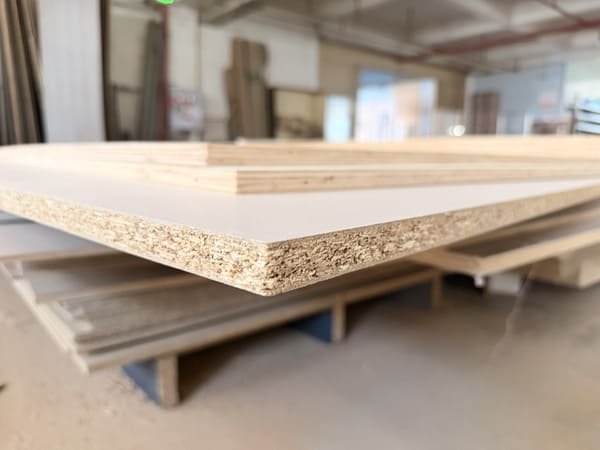
During actual processing, we have encountered loose panel edges, larger particles falling away, and edge chipping during cutting. These signs may indicate an abnormal core condition, but they do not directly prove that the panel does not meet the required internal bond strength.
Thickness Swelling and Moisture Risk
Thickness swelling after water immersion measures the percentage increase in panel thickness after immersion under specified conditions. Particleboard standards in different markets evaluate moisture-related dimensional stability according to the panel’s intended use, grade, and test conditions.
This indicator helps evaluate how stable a panel remains after water exposure. However, a laboratory immersion test is not completely equivalent to the actual conditions experienced by a finished cabinet.
Moisture can enter the substrate more easily through panel edges, drilled openings, joints, and areas with weaker edge protection. Even when a panel has been finished and edge-banded, it should not be considered completely waterproof. Surface and edge-banding quality, hole treatment, transportation, and on-site storage all influence moisture risk.
After particleboard swells because of moisture exposure, its original thickness and edge condition may not fully recover, even after it dries again.4
Based on our current experience with standard melamine-faced particleboard, we normally give priority to other substrates for kitchens, bathrooms, and locations exposed to persistent humidity, standing water, or direct water contact. Moisture-resistant particleboard should be assessed separately according to its specific grade, test basis, and intended installation location.
Formaldehyde Emissions
Formaldehyde emissions must be confirmed when purchasing particleboard, plywood, and other wood-based panels. Although the applicable limits and standards may vary by panel type and target market, the basic verification process is similar.
The details that should be checked were explained in our previous article, How to Evaluate Plywood Quality: Key Indicators and Inspection Methods in Cabinet Production, so they are not repeated here.
How We Inspect Particleboard During Cabinet Production
Thickness and Surface Inspection
The material most commonly used in our factory is 18 mm standard melamine-faced particleboard. When the material arrives, we use a calliper to check the panel thickness. The inspection method is the same as the one explained in our previous plywood article, so it is not repeated here.
We also inspect the decorative surface. We check for visible scratches and confirm that the colour, texture, and grain direction match the order requirements. At the same time, we observe whether the panels show obvious warping.
Observations During Cutting and Edge Banding
Before a panel is cut on the CNC router, visible warping may prevent it from making stable contact with the worktable. It can then be more difficult to form a reliable seal between the panel and the table, reducing the stability of the vacuum hold-down during cutting.
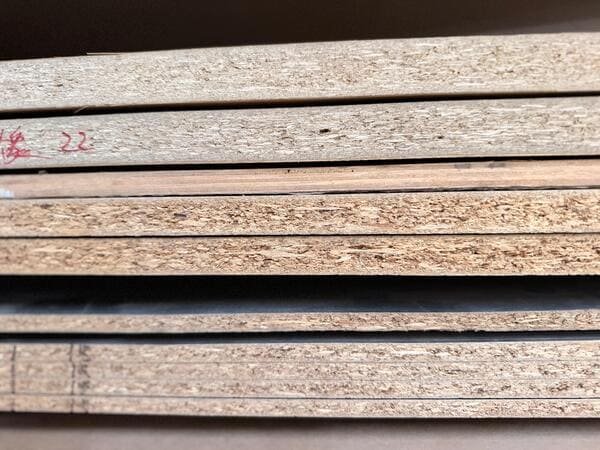
When edge chipping occurs during cutting, we continue to observe the panel after the cutting process. Chipping may also be related to tool condition or machining parameters, so it should not automatically be attributed to the panel itself.
After cutting and before edge banding, we lightly rub the panel edge to observe particle loss. Based on our actual observations, an edge in a normal condition usually releases only a small amount of fine wood dust.
During edge banding, we also observe whether an unusual amount of wood dust or larger particles remains on the equipment. When the core near the edge is visibly loose and an edge band must be removed, a cured PUR-bonded edge band may sometimes pull away part of the core with it.
This may indicate an abnormal internal bonding condition, but it cannot replace an internal bond strength test.
A Moisture Problem During Transportation and Temporary Storage
We once encountered a moisture problem involving cabinet parts made from standard melamine-faced particleboard.
After processing, the parts were packed in relatively thin corrugated cardboard and transported to the project site. It rained during unloading. The outer cartons became wet, and some parts were temporarily placed in an area with a small amount of standing water.
We did not notice any obvious problem at the time. However, when the packaging was opened for installation the next day, we found that some edge-banded areas had already swollen and the panel edges showed visible bulging.
We did not install the affected cabinet parts. We remade them instead.
We subsequently changed the packaging method. Foam cushioning was added between the parts, thicker corrugated cardboard was used, and waterproof kraft paper was added as the outer layer. During unloading and temporary storage, the parts are also kept away from wet floors and locations where water may collect.
This problem occurred before installation rather than after long-term cabinet use. It showed that standard particleboard should not be considered completely waterproof, even after melamine finishing and edge banding. Protection from rain, moisture, and direct floor contact during transportation, unloading, and temporary storage also affects final delivery quality.
What Can Be Identified On Site, and What Requires Testing?
Incoming inspection and processing observations can help identify surface damage, visible warping, core voids, unusual particle loss, edge chipping, and moisture swelling that has already occurred.
However, these observations are not enough to prove that a performance indicator has failed. Internal bond strength, thickness swelling, and formaldehyde emissions must still be confirmed through test documents that correspond to the actual product being purchased.
Final Notes
Particleboard quality cannot be judged only by particle size, panel weight, or surface appearance. Internal bond strength, thickness swelling, formaldehyde emissions, and actual processing performance should be considered together.
In custom cabinetry, Horace Home selects substrates according to the budget, installation location, and moisture risk. We generally prefer to use standard melamine-faced particleboard in dry interior areas. For orders with specific standard requirements, the panel specifications, decorative finish, and relevant test documents should also be confirmed before production.
Based on the publicly available readable version of GB/T 4897—2015, *Particleboard*. ↩
Based on the public preview of EN 312:2010, *Particleboards — Specifications*. ↩
Based on particleboard information and ANSI A208.1—2022 performance data published by the Composite Panel Association (CPA). ↩
Based on the Composite Panel Association (CPA) technical bulletin on the dimensional stability of particleboard and MDF. ↩