

A client recently asked us about using matte anti-fingerprint PET cabinets in his kitchen. After we discussed the project in more detail, we found that he thought PET was one single type of board. So I think it is necessary to explain what PET cabinet finish actually is.
PET is usually used as a decorative surface on cabinet doors or panels. It is laminated onto substrates such as MDF. PET itself is not the complete cabinet door structure. In actual production, we still need to confirm the substrate, front and back materials, film thickness, and edge banding.
In other words, the client is not buying one single board called “PET.” They are buying a composite panel with PET used as the surface finish.
If you are sourcing PET cabinet doors for a project, the real question is not simply, “Do you have PET?” The better question is: what is behind the PET surface?
What Is PET Cabinet Finish?
PET stands for Polyethylene Terephthalate.
In cabinet applications, PET is usually used as a decorative film. It is laminated onto substrates such as MDF or plywood. The finished panel is then processed into cabinet doors or other cabinet parts.
So when a buyer sees the term PET laminated MDF, it means an MDF panel that already has PET laminated onto its surface. It does not mean one single raw material.
Several terms are often mixed together in purchasing communication:
- PET film: the PET film used on the surface.
- PET laminated MDF: an MDF panel with PET already laminated onto the surface.
- PET cabinet door: a cabinet door made after the panel is cut, edge banded, and processed.
These terms describe different product concepts. They should not be treated as exactly the same thing.
What Is a PET Cabinet Door Actually Made Of?
If we break down a PET cabinet door, it can usually be divided into four parts:
front surface + substrate + back surface + edge banding
Each part should be confirmed separately.
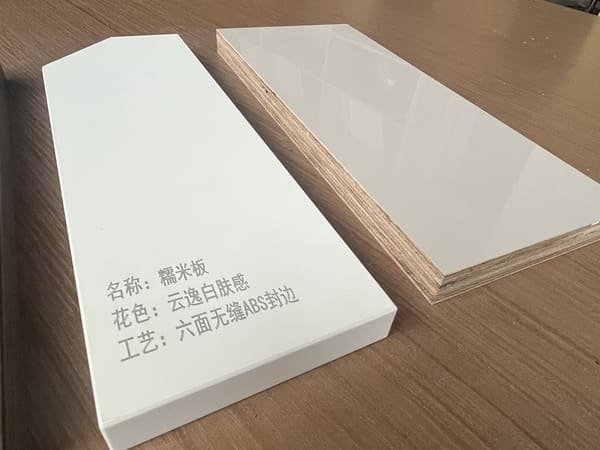
In the PET cabinet doors we have actually produced, we have used configurations including:
- 0.3 mm or 0.5 mm PET film;
- MDF or plywood substrate;
- PET on both the front and back;
- 1 mm PVC edge banding;
- PUR edge banding process.
These are configurations we have actually used. They are not an industry-wide standard.
Other suppliers may use a different PET film thickness, substrate, or back material, while still calling the final product a PET cabinet door.
Why Is MDF a Common Substrate for PET Lamination?
In the PET cabinet doors we have produced, MDF is one of the more common substrates.
One important reason is that MDF has a relatively smooth and uniform surface.1 For a flat finish such as PET, the condition of the substrate can directly affect the final surface.
In our material selection, when we use high-gloss PET, we pay more attention to the flatness of the substrate and small surface defects.
However, this does not mean PET can only be laminated onto MDF.
We have also used plywood as the substrate.
Compared with MDF, we pay more attention to the surface condition, face layer quality, and PET film when using plywood. The surface and core structure of plywood can vary more, so the final surface result should not be judged only by the word “plywood.”
There is one point we want to make clear.
We have previously used 0.5 mm PET film on a plywood substrate. However, we do not have internal test data showing that plywood requires a specific minimum PET film thickness.
For this reason, we do not use one film thickness as a general rule for all plywood applications.
Are Both Sides of a PET Cabinet Door Always PET?
Not necessarily.
The PET panels we currently use have PET on both the front and back. One reason is to keep the structure and performance on both sides as similar as possible. This can help reduce the risk of deformation caused by an unbalanced panel.2
However, double-sided PET is not the only structure used for PET cabinet doors.
There are also products on the market that use PET on the front and another material on the back, such as PP.
If the back surface has a similar color, a door with a different back material may look very similar to a door with PET on both sides.
The same color on the back does not mean the same material is used.
If a project has specific requirements for the material, color, or gloss on both sides of the door, these points should be confirmed separately. It is not enough to simply write “PET” in the material specification.
From Pre-Laminated Panels to Finished Cabinet Doors: Our Actual Process
The PET lamination process is not completed in our own factory.
According to our partner factory, the PET panels we currently use are laminated by cold pressing. The finished pre-laminated panels are then delivered to our factory.
After the panels arrive, our basic process is:
receiving → inspection → CNC cutting and necessary drilling → edge banding → sorting → inspection → packing
During incoming inspection, we mainly check the PET surface for obvious scratches, damage, or other visible defects. We also inspect the core condition from the side of the panel.
The later processing steps are similar to the way we handle melamine-faced panels. The large surfaces are already finished. The cabinet factory mainly handles cutting, edge banding, and other panel processing.
We will not repeat that process in detail here. If you want to understand how pre-finished panels are processed after arriving at a cabinet factory, you can also read our previous article about melamine-faced panels.
Why Does a PET Cabinet Door Still Need Edge Banding?
If the panel already has a PET surface, why does it still need edge banding?
In the PET pre-laminated panel structure we currently use, PET mainly covers the large flat surfaces. It does not continuously wrap the cut edges created after CNC cutting.
After the panel is cut, the substrate is exposed around the edges. These edges therefore need separate edge banding.
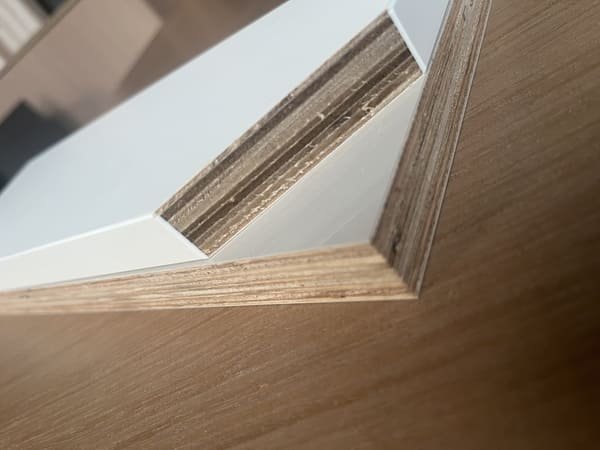
In later cabinet processing, this is similar to melamine-faced panels. The large surfaces are already finished, and the exposed edges are treated after cutting.
In our current structure, we use:
1 mm PVC edge banding + PUR edge banding process
This means that the large surface of the finished PET cabinet door is PET, while the edges use PVC edge banding.
This also creates an important point during sample approval.
Even if the PET surface and PVC edge banding are both called “white” or “black,” there can still be differences in color or gloss. The final result should therefore be confirmed with an actual combined sample.
This structure is different from the PVC thermofoil structure we introduced in our previous article.
Common PET pre-laminated panels are finished on the large flat surfaces first and then edge banded separately. PVC thermofoil can be membrane pressed over shaped surfaces and edges.
For more details about the structure and production process of PVC thermofoil, you can read our previous article. We will discuss the detailed differences between PET and PVC thermofoil in structure, processing, and application in a separate article later.
How Thick Is PET Film?
We have actually used PET film with thicknesses of 0.3 mm and 0.5 mm.
These are based on our actual production experience. They are not standard thicknesses for the whole market.
From discussions with factories, we have also heard of PET film options such as 0.2 mm, 0.3 mm, and 0.5 mm. However, this information came from factory discussions. It is not our own verified market research.
We have not confirmed one dominant thickness for different markets, so we do not describe any single thickness as an industry standard.
What we can confirm is that there is no one “standard PET thickness” that applies to every product.
PET film thickness needs to be considered together with the complete product structure, including:
- substrate;
- front and back materials;
- edge banding;
- final application.
A thicker PET film does not automatically mean a better product.
Film thickness is only one part of the complete structure. It only becomes meaningful when considered together with the rest of the product.
PET, PETG, 2DL and 3DL: Terms That Are Easy to Confuse
PET, PETG, 2DL, and 3DL often appear in technical information from different manufacturers.
There is no need to make these terms too complicated, but a few basic differences are important.
PET and PETG are related polyester materials, but they are not exactly the same.
2DL and 3DL mainly describe lamination and forming methods. They are not the names of specific plastic materials.3
The PET cabinet panels we currently use follow a flat-panel processing method. The PET surface is already laminated before the panels arrive at our factory. We then cut and edge band the panels.
However, some PET products can also be used for 3D thermoforming.
There are products on the market clearly described as 3D PET laminate.
If a project involves thermoforming, curved surfaces, or complex shapes, the correct approach is to check the TDS of the specific film product. The forming ability should not be judged only from the name “PET.”
For normal flat PET cabinet doors, this level of understanding is usually enough.
What Specifications Should Buyers Confirm for PET Cabinet Doors?
If a project only says:
PET cabinet door
we do not think that is enough information to move directly into production.
The actual specification should include:
| Item to Confirm | Why It Matters |
|---|---|
| Color | The approved sample should be used as the reference, not only the color name |
| Gloss level | Matte, semi-matte, and high-gloss can be different products |
| Surface requirements | For example, anti-fingerprint performance should be confirmed for the specific product instead of being assumed from the word “PET” |
| Film thickness | It is part of the complete structure and should not be used alone as a quality indicator |
| Substrate type | MDF, plywood, and other substrates should be confirmed separately |
| Panel thickness | It can affect door weight, hardware selection, and how the door is used |
| Front and back materials | Confirm whether both sides use PET or whether the back uses a different material in a similar color |
| Edge banding material | PVC is common, but the actual material should still be confirmed |
| Edge banding thickness | This is a separate specification from PET film thickness |
| Edge banding color / gloss | It should be checked against the actual surface sample instead of being assumed to match |
For B2B projects, I prefer to include these details in the material confirmation sheet or approved sample process. I do not rely on one material name to define the whole product.
This also brings us back to the client mentioned at the beginning of this article. He wanted a matte anti-fingerprint PET cabinet finish.
“Matte” and “anti-fingerprint” cannot be confirmed only from the word “PET.” They are surface appearance and performance requirements of a specific product. They should be confirmed after the actual PET product has been selected.
If these details are not confirmed, two suppliers may both quote a “PET cabinet door” while actually offering different product structures.
Final Notes
The structure of a PET cabinet door cannot be determined only by the material name “PET.” The same PET surface can be combined with different substrates, back materials, and edge banding materials.
For custom cabinetry projects, a more reliable approach is to confirm the front surface, substrate, back material, film thickness, and edge banding together. The final color and gloss should also be confirmed with an actual sample.
At Horace Home, we also confirm these materials and structural details before production. We then move on to cutting, edge banding, and the remaining production steps.
Based on information from the Composite Panel Association (CPA) *Medium Density Fiberboard (MDF)*. ↩
Based on information from the Composite Panel Association (CPA) *Minimizing Warp in Laminated Particleboard and Medium Density Fiberboard*. ↩
Based on information from the Composite Panel Association (CPA) *Surface & Panel Master 2021*. ↩