
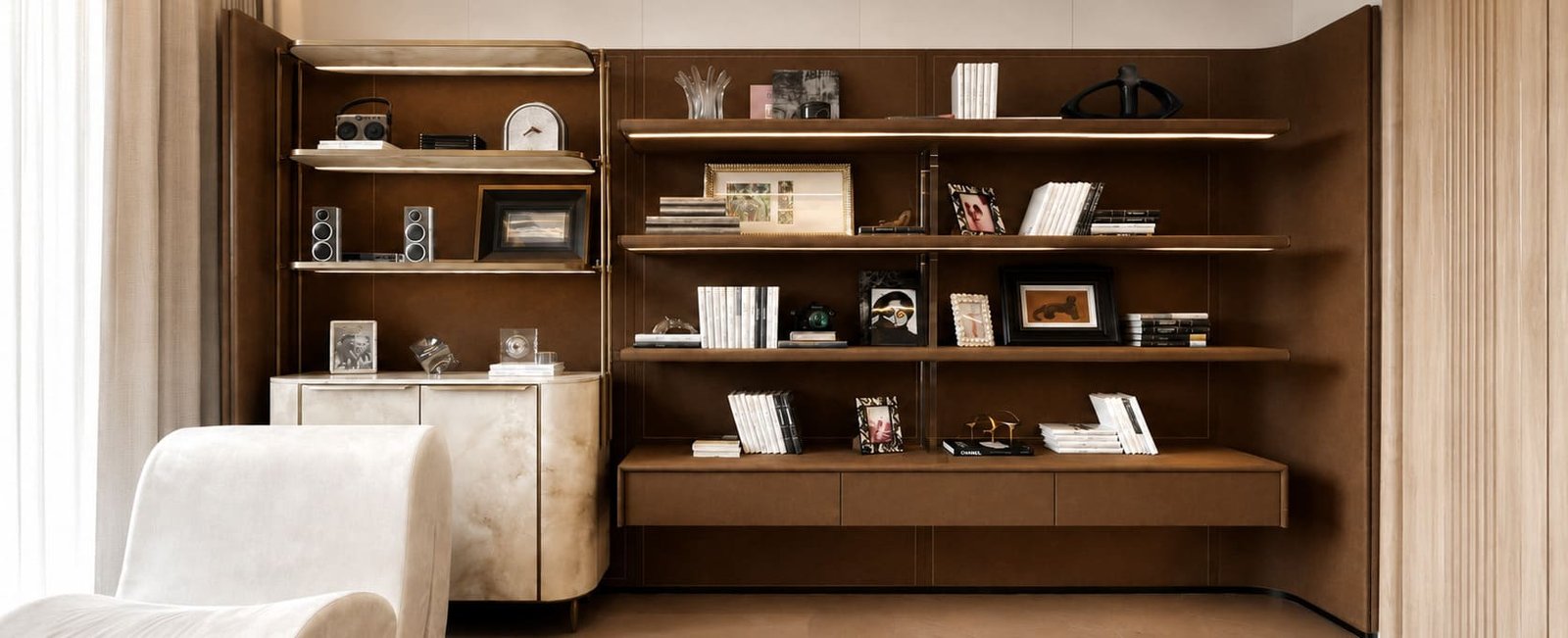
Melamine-faced boards are common in custom cabinetry. We often hear terms such as “Melamine Board,” but this name alone does not fully explain what the board is made of.
This is because melamine mainly describes the surface finish of the board, while different substrates can be used underneath. This can easily cause confusion. In this article, we will start with this difference and look at how a melamine surface is made and how it is commonly used in cabinetry.
What Is Melamine-Faced Board?
A melamine surface is usually made by impregnating decorative paper with melamine resin, drying it, and then bonding it to a board substrate through heat and pressure. The solid colors, wood grains, and other decorative effects we see mainly come from this decorative paper.1
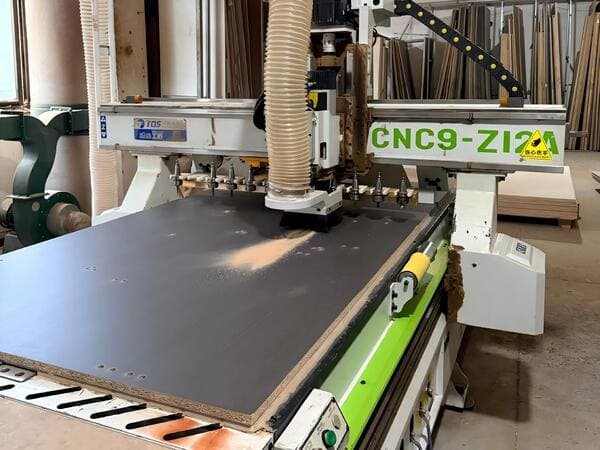
The surface is already bonded to the substrate during board production, so it is different from a painted finish that is applied later. Once the surface is finished, the board can go directly to cutting, drilling, edge banding, and other processing steps.
From a structural point of view, melamine mainly describes the surface finish rather than the internal substrate. To know whether the substrate is particleboard, plywood, or MDF, we still need to check the board specification.
Why Does “Melamine Board” Not Mean One Specific Substrate?
A melamine surface needs to be combined with a substrate to form a complete board. So when we only see the term “Melamine Board,” we still cannot tell what material is used inside.2
In our factory, the melamine-faced boards we have actually used mainly include the following combinations:
| Surface | Substrate | Common Description |
|---|---|---|
| Melamine finish | Particleboard | Melamine Particleboard |
| Melamine finish | Plywood | Melamine-faced Plywood |
| Melamine finish | MDF | Melamine MDF |
These boards can have similar colors and surface patterns, but their internal structures are different.
Particleboard is the substrate we use most often. Because of this, in our daily factory communication, if someone only says “18mm melamine board,” we usually understand it as 18mm particleboard with a melamine finish. If plywood or MDF is used instead, we normally specify the substrate separately.
For example, in a villa project we worked on before, the client first confirmed a wood-grain melamine finish. Later, when we confirmed the detailed material specification, we selected plywood as the substrate for the cabinet boxes and particleboard for the flat cabinet doors based on the application and structural requirements of each part. Both boards used a wood-grain melamine finish, but their substrates were different.
So the same melamine finish can be used with different substrates. The substrate still needs to be selected according to the specific location and requirements.
How Do We Confirm the Color and Texture of a Melamine Surface?
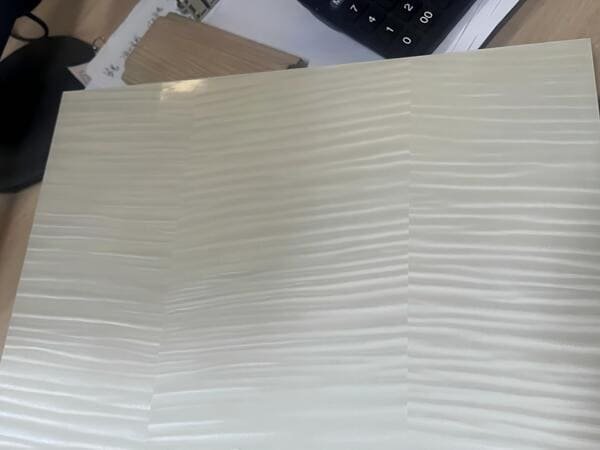
Melamine surfaces can be made in solid colors, wood grains, and other decorative effects. In addition to color, the surface texture and gloss also affect how the final board looks and feels.
When confirming materials, we usually do not confirm only a general color name. For example, even if two finishes are both called Oak, they may still differ in shade, grain pattern, and surface feel. So we normally confirm the color and texture together.
If the client already has detailed material requirements, such as a physical sample or a specified brand and color code provided by a large developer, we will match the board according to that information.
More often, clients provide a rendering or reference image. In this case, we first look for a similar color and texture from the physical color cards provided by our board suppliers. We then make a sample using the actual substrate and melamine surface. The sample sizes we commonly use are about 200 × 300 mm or 300 × 400 mm. After that, we send the sample to the client for confirmation.
We usually recommend confirming the material with a physical sample. Photos and videos can be affected by lighting, cameras, and screen displays, so there may be a slight color difference compared with the real sample. If the client chooses to confirm by photo or video, we will also explain whether the actual sample looks slightly darker or lighter than it appears in the image.
Compared with color, surface texture is usually easier to judge through photos or videos. However, if the project has strict color requirements, a physical sample is still more reliable.
How Is Melamine-Faced Board Processed into Cabinet Parts?
The melamine-faced boards we purchase are usually full sheets with the surface already finished on both sides. Both sides have the same color and texture. After the boards arrive at the factory, they do not need additional painting and can go directly into cabinet production.
Our basic production process is:
Incoming material → Inspection → Cutting → CNC or drilling → Edge banding → Sorting → Inspection → Packaging
After cutting, the substrate is exposed around the edges of each panel. These edges therefore need to be edge banded according to the board color and design requirements. This covers the exposed panel edges and helps keep the surface and edge appearance visually consistent.
For wood-grain melamine surfaces, we also consider the basic grain direction during layout and cutting. For example, large visible cabinet side panels normally use a vertical wood-grain direction. However, for standard melamine-faced boards, we usually do not use the same detailed continuous grain matching used for wood veneer cabinet doors.
In most cases, we use double-sided boards, but there are exceptions. For some cabinet doors that need another material to be laminated onto them later, we may choose a single-sided board according to the next processing step.
Where Is Melamine Commonly Used in Cabinets?
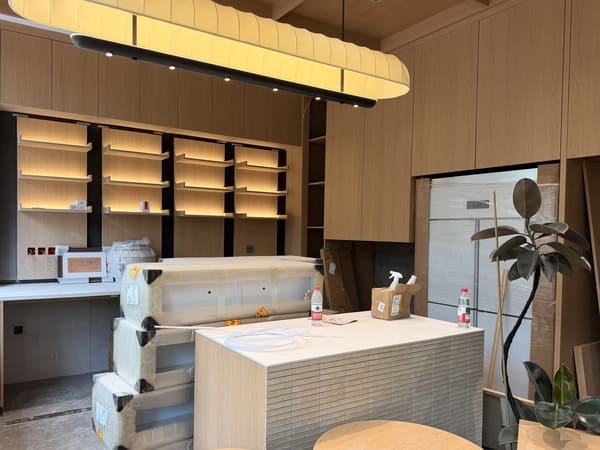
In our actual production, melamine surfaces can be used on most cabinet parts, including side panels, top and bottom panels, shelves, internal partitions, and flat cabinet doors without complex profiles.
However, using the same melamine finish does not mean that all these parts need to use the same substrate. When confirming materials, we also select particleboard, plywood, or other substrates according to the space and the location of the panel.
For example, if a panel is used in a more humid area or has higher load-bearing or structural requirements, we first consider whether the substrate needs to be changed. The material requirements of the client’s target market can also affect the final choice.
So in cabinet applications, melamine is mainly the surface finish of the board. Whether the board is suitable for a specific location still needs to be considered together with the substrate.
How Do We Confirm the Melamine-Faced Board a Client Needs?
If a client’s drawing or material requirement only says “18mm Melamine Board,” the information is usually not complete enough.
We first confirm the substrate. If the client has already specified particleboard, plywood, or another material, we continue according to that requirement. If the client does not have a clear substrate requirement, we usually give an initial suggestion based on the application area, panel location, structural requirements, and the material requirements of the target market.
We then confirm the specific melamine surface, such as whether it is a solid color or wood grain, the exact color, the surface texture, and whether a physical sample is needed.
In our material list, we normally describe the substrate and surface separately. For example:
Substrate: 18mm plywood
Surface: wood-grain melamine finish
This makes it easier to match the later color, texture, and processing requirements to the correct board.
Final Notes
A melamine surface is only one part of a cabinet board. When confirming a melamine-faced board, we also need to know what substrate is used underneath, where the board will be used, and what color and texture are required.
When Horace Home confirms this type of material, the substrate, board thickness, color, and surface texture are checked separately before the final specification is determined according to the project requirements. This helps reduce misunderstandings caused by using only the term “Melamine Board” and makes it easier to translate the material requirements into clear drawings and production specifications.