
Some clients ask for the same material to be used for both cabinet bodies and cabinet doors. Some clients also see plywood as a higher-grade option. However, in actual production, cabinet bodies and cabinet doors have different functions. Their requirements for structure, surface finish, and use environment are also different.
When choosing base materials for whole-home custom cabinetry, we normally do not choose one panel first and then use it for every part. Instead, we first consider the use conditions, and then choose suitable materials for the cabinet bodies and cabinet doors separately.
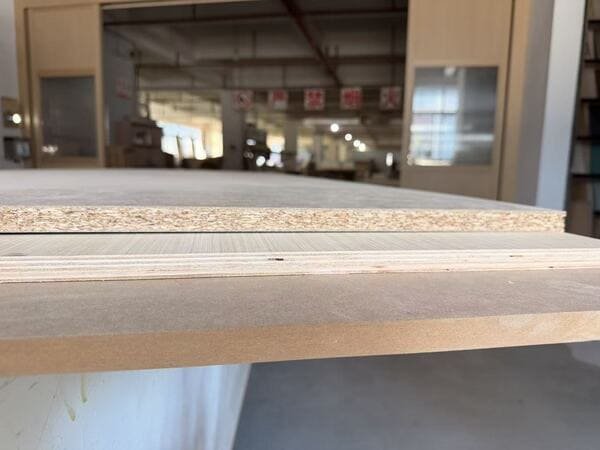
This article will discuss the use of plywood, particleboard, and MDF in cabinet bodies and cabinet doors. It will also explain how these base materials can be combined for different types of furniture.
Separating Furniture Parts
In whole-home custom cabinetry, cabinet bodies and cabinet doors have different functions. The main points to consider when choosing base materials are also different. For cabinet bodies, the main considerations are the use environment, structure, and load capacity. For cabinet doors, the main considerations are the surface finish, shape, and appearance.
Therefore, cabinet bodies and cabinet doors do not always need to use the same base material. In the following sections, we will compare the use of plywood, particleboard, and MDF for these two parts.
Key Comparison of Plywood, Particleboard, and MDF
Before discussing material selection for cabinet bodies and cabinet doors, we will first use a table to make a simple comparison of the three base materials in several key areas. Please note that the table below is a general summary based on panels with similar thickness and product quality. It cannot represent the actual performance of every product.
| Comparison | Plywood | Particleboard | MDF |
|---|---|---|---|
| Structural load capacity | Usually has good bending resistance and load capacity, but it is affected by wood species, number of layers, and core quality | Can meet normal furniture structure requirements, but long-span panels need suitable thickness and support design | Has a relatively uniform structure and can meet normal use requirements, but long-span panels also need additional support |
| Moisture resistance | Usually has relatively good stability after exposure to moisture, but ordinary plywood is not waterproof | Ordinary products are sensitive to moisture, while moisture-resistant products can improve performance | Ordinary products are sensitive to moisture, while moisture-resistant products can improve performance |
| Screw-holding strength | Usually good, but it can be affected by core voids and screw position | Can meet normal furniture connection requirements, but it is affected by panel quality, connectors, and pre-drilling | Screw holding on the panel face is relatively uniform, while edge connections depend more on the screw type and pre-drilling |
| Risk of warping and deformation | Affected by core quality, moisture content, and whether the finishes on both sides are balanced. Large panels need more attention to warping | The panel surface is usually relatively flat, but moisture or unbalanced treatment on both sides can still cause deformation | The internal structure is uniform and the panel surface is usually relatively flat, but moisture or unbalanced treatment on both sides can still cause deformation |
| Shaping and machining ability | Can be grooved and used for simple shapes, but the layered structure will be visible on the machined surface | Suitable for normal cutting and drilling, but not suitable for complex routing | Suitable for routing, carving, sanding, and complex shapes |
| Overall cost | The base material cost is usually relatively high | Material and processing costs are usually easier to control | The base material cost is usually moderate, but shaping, sanding, and finishing will increase the total cost |
The costs in the table only reflect common material and processing conditions. Actual costs will also be affected by the panel brand, specifications, finishing process, and purchasing region.
The table shows that no single material performs better than the other two in every area.
For example, when the grade and thickness are similar, plywood usually has some advantages in structural load capacity, moisture resistance, and screw-holding strength. However, this does not mean that large cabinet doors made from plywood always have a lower risk of warping. Plywood core quality, moisture content, door size, and whether the finishes on both sides are balanced1 can all affect the flatness of the cabinet door. In comparison, particleboard and MDF have a more uniform internal structure. They are usually easier to control in terms of flatness and batch consistency for flat cabinet doors.
Therefore, when choosing a base material, we should not only judge which material is better. We should choose according to the specific furniture part, surface finish, and use conditions. Below, we will discuss cabinet bodies and cabinet doors separately.
How to Choose a Base Material for Cabinet Bodies
In relatively dry indoor environments, particleboard can normally meet the use requirements of most standard cabinet bodies. However, for positions close to water, areas with higher humidity, or locations with higher structural load requirements, we usually consider plywood first.
MDF can also be used for cabinet bodies, but ordinary MDF is sensitive to moisture. With the same specifications, MDF is also usually relatively heavy. Using it for a large number of cabinet bodies will increase panel weight and make handling and transportation more difficult. Therefore, in our regular production, we normally do not use MDF as the first choice for cabinet bodies.
In addition to the base material itself, panel thickness, shelf span, support method, edge banding, and connection structure will also affect the long-term performance of the cabinet body. Therefore, the cabinet body material still needs to be confirmed according to the specific drawings and use conditions.
How to Choose a Base Material for Cabinet Doors
For flat cabinet doors with a melamine finish, particleboard is usually easier to control in terms of panel flatness and batch consistency. Plywood can also be used for flat cabinet doors, but as mentioned above, more care is needed for large door panels.
For shaped cabinet doors that require routing, carving, painting, or PVC membrane pressing, MDF is usually more suitable. Its internal fibre structure is relatively uniform2. After machining, it does not easily show obvious particles or plywood layers. This makes later sanding and surface finishing easier.
When the cabinet door is large, the panel weight, warping risk, and number of hinges also need to be considered. For positions close to water, the moisture-resistant grade of the base material should be confirmed. The edges of the door and the drilled holes should also be properly protected.
How to Confirm Material Combinations for Different Use Environments
Material combinations for different types of furniture mainly depend on the use environment and the cabinet door finish. The material should not be selected only by the furniture type. We normally divide furniture into areas that are humid or have moisture risks, and relatively dry indoor areas.
Humid Areas or Areas with Moisture Risks
Kitchen sink cabinets, cabinets near dishwashers, bathroom vanities, and laundry cabinets can all face moisture risks from water vapour, pipe leaks, or water on the floor.
For cabinet bodies in these areas, plywood with consistent quality can be considered first. Moisture-resistant particleboard can also be selected according to the specific requirements. For flat cabinet doors, moisture-resistant particleboard can be used according to the actual use conditions. For painted or shaped cabinet doors, moisture-resistant MDF can be used.
It is important to note that moisture-resistant panels are not waterproof materials. Edge banding, openings, pipe positions, and protection at the bottom of the cabinet will also affect long-term performance.
Relatively Dry Indoor Areas
Wardrobes, TV cabinets, entryway cabinets, bookcases, sideboards, and storage cabinets are usually used in relatively dry environments.
For these types of furniture, plywood or particleboard can be selected for the cabinet bodies according to the structural requirements and budget. Flat cabinet doors can normally use particleboard. Painted, PVC membrane-pressed, or other shaped cabinet doors normally use MDF.
How We Confirm the Final Material Plan
After receiving the client’s drawings, we normally first separate the different furniture according to their use areas. We then confirm the materials and surface processes for the cabinet bodies, flat cabinet doors, and shaped cabinet doors separately. If the client does not have clear material requirements, we will provide an initial recommendation based on the use environment, panel dimensions, and surface effect. We will then consider the budget and target market requirements, and write the panel name, thickness, and finish into the drawings or material list for the client to confirm.
During this process, we also need to consider how the furniture will be used and cleaned. We once produced cabinets for a hotel project. The client originally selected ordinary particleboard as the base material for the cabinet bodies. Because hotels are cleaned frequently and the bottom of the cabinets could come into contact with water on the floor, we recommended changing the cabinet bodies to plywood. However, the client still insisted on the original material plan.
After the cabinets were put into use, water came into direct contact with the cabinets during cleaning. Some panels later absorbed water, swelled, and became deformed. This experience also made us pay more attention to the distance between cabinets and the floor or nearby water sources when confirming materials for later projects. We also pay more attention to the cleaning methods that may be used at the site.
This does not mean that plywood can come into direct contact with water. For positions with moisture risks, in addition to choosing a relatively suitable base material, proper edge banding and protection around openings and the bottom of the cabinet are still needed. The panels should also not remain in contact with standing water for a long time.
Based on these considerations, the material combinations we commonly produce include plywood cabinet bodies with particleboard flat doors, plywood cabinet bodies with MDF shaped doors, particleboard cabinet bodies with particleboard flat doors, and particleboard cabinet bodies with MDF shaped doors.
Final Notes
A suitable material combination is not always the most expensive option. It is the option that matches the actual use. Many problems that appear later are not caused by the material itself not meeting the required quality. They happen because the use environment, cleaning method, or surface process was not fully considered during material selection.
Therefore, before quotation and production, it is usually more important to confirm the suitable use and limitations of the materials than to simply specify one type of panel.
If you are preparing a custom cabinetry or whole-home woodwork project, Horace Home can review the drawings, renderings, and initial material requirements you provide and help identify the base materials, finishes, and risk areas that need to be confirmed for different parts. This can help make the material plan clearer before production.