
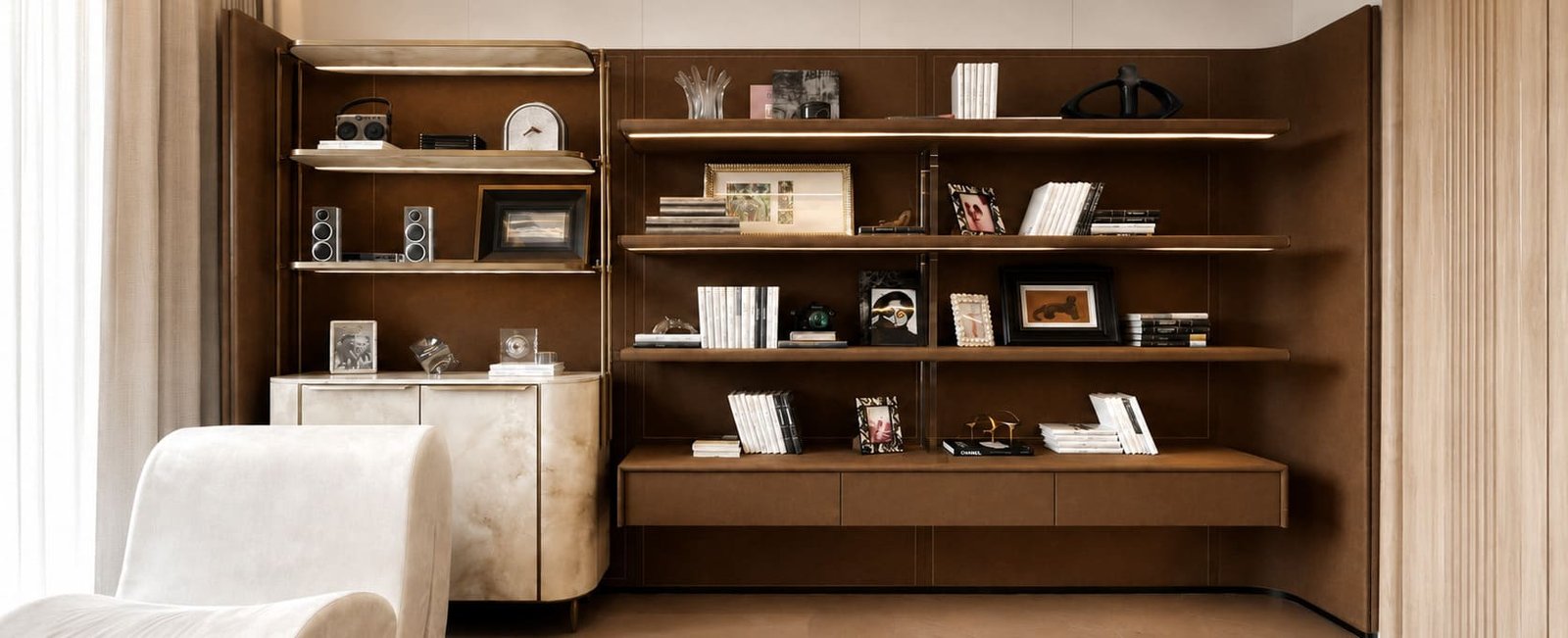
On our materials page, we have already introduced the main advantages, limitations, and common applications of plywood. This helps customers understand the material quickly. In this article, we will discuss plywood in more detail.
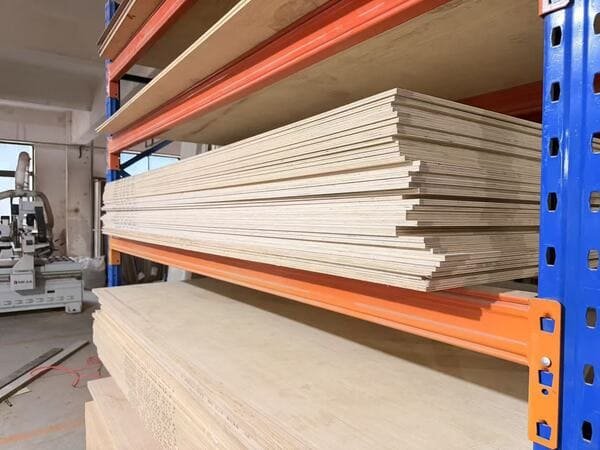
What Is Plywood?
Plywood is made by stacking and bonding multiple thin wood veneers. It normally uses an odd number of layers or a relatively balanced layer structure.1 The grain directions of adjacent veneers are arranged in different directions.
This structure helps balance forces and dimensional changes in different directions. It also reduces the effect of wood expansion or shrinkage along a single grain direction.
Adhesive is applied evenly between the veneer layers. Common adhesives include urea-formaldehyde resin adhesive, known as UF, and melamine-modified urea-formaldehyde resin adhesive, known as MUF.
Based on publicly available production information, the common hot-press temperature for plywood is approximately 115–140°C, with pressing pressures of around 0.8–2.5 MPa2. Some high-density wood species may require higher pressure. The actual settings depend on the adhesive type, wood species, veneer moisture content, number of layers, and panel thickness.
In terms of structure, plywood normally consists of a face veneer, core veneers, and a back veneer.
The face veneer is the outermost layer on the front of the panel. It mainly affects the appearance, surface flatness, and the result of later finishing.
The core consists of the internal veneer layers. It is an important part that affects panel stability, edge quality, and machining performance.
The back veneer is the outermost layer on the rear of the panel. Together with the face veneer, it helps keep the panel structure balanced.
A Brief History of Plywood
Early use of laminated wood can be traced back to ancient Egypt, where people had already started placing thin wood layers together.
By the 19th century, the basic cross-layered structure of modern plywood had gradually developed.
In the early 20th century, improvements in rotary cutting, adhesive application, and pressing equipment allowed plywood to enter industrial production. It then became widely used in furniture, cabinetry, construction, and transportation.
Common Plywood Sizes and Surface Grades
Common Plywood Sizes
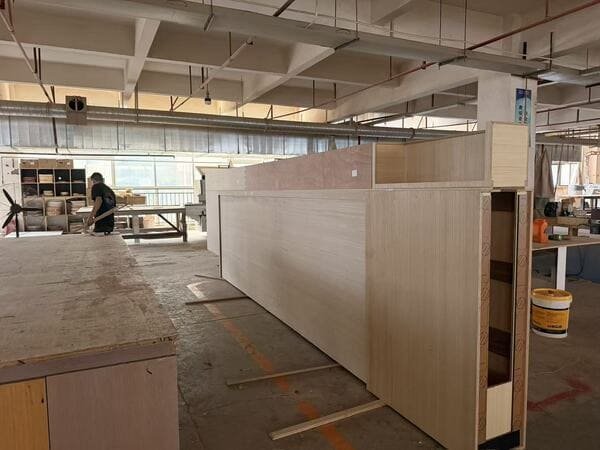
A common plywood panel size is 1220 × 2440 mm. Some suppliers can also provide special-length panels according to order requirements.
In one real estate sales center project, the longest plywood panel we used was 4200 mm. It was mainly used to reduce joints in shaped components.
Within the supply range we currently work with, available thicknesses include 3 mm, 5 mm, 9 mm, 12 mm, 15 mm, 18 mm, 22 mm, and 25 mm.
Please note that nominal thickness does not always equal the actual measured thickness. Different plywood products have permitted manufacturing tolerances.
Common Plywood Surface Grades
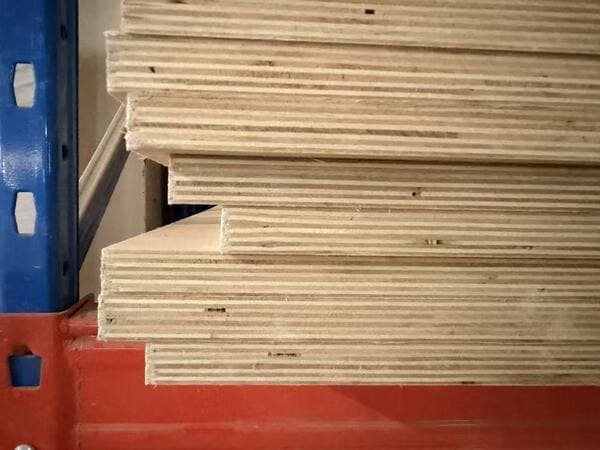
In some markets and commercial specifications, letters such as A, B, C, and D are used to describe the appearance grade of the surface veneer.
The permitted defects for each grade may vary between countries, standards, and suppliers. The following table is only intended to explain the common differences between these grades.
| Grade | Appearance | Typical Applications |
|---|---|---|
| A | Smooth and refined surface, more consistent grain, and fewer visible knots, cracks, or repairs | Transparent finishes, directly exposed surfaces, and furniture parts with higher appearance requirements |
| B | Relatively smooth surface with limited color differences, small knots, or repaired defects | Good balance between appearance and cost; suitable for general furniture, visible cabinet surfaces, and base panels for later finishing |
| C | More visible color differences, knots, veneer joints, and repairs, with lower appearance consistency | Opaque finishes, cabinet interiors, and base panels that are not directly visible |
| D | More visible natural defects and repairs, with lower surface appearance requirements | Back surfaces, hidden areas, packaging, and other applications with low appearance requirements |
For products that use two-letter surface grades, markings such as A/A or A/B normally describe the grade combination of the front and back surfaces. The exact meaning should still be confirmed according to the grading standard used by the supplier.
Common Core Wood Species Used in Plywood
Plywood can be made with veneers from different wood species. The table below lists several common core wood species and their general differences.
Please note that these descriptions refer to the plywood core. The core wood species does not represent the wood species used for the face veneer.
| Wood Species | Relative Weight | Relative Core Compactness | Machining Characteristics |
|---|---|---|---|
| Poplar | Relatively light | Relatively low | Easy to cut, drill, and machine, with less load on equipment |
| Pine | Medium or relatively light | Depends on the pine species | Generally easy to machine |
| Eucalyptus | Relatively heavy | Relatively high | Usually creates more cutting resistance and places higher demands on tools |
| Birch | Relatively heavy | High and fine-textured | Good machining accuracy, with generally clean and regular panel edges |
| Mixed wood species | Depends on the combination | Depends on the combination | Different wood combinations can be used to adjust machining performance |
The table shows general characteristics rather than fixed performance results.
Actual performance is also affected by veneer grade, number of layers, layer arrangement, adhesive type, hot-pressing process, moisture content, and internal core defects.
How We Select Plywood for Custom Cabinetry
Selecting Specifications According to Size and Application
We first confirm whether the customer requires standard-size panels or special-size panels. We then select the thickness according to the position and function of each cabinet part.
In our standard panel-based cabinet construction, we normally use 9 mm plywood for back panels and 18 mm plywood for cabinet bodies and standard cabinet doors.
For taller cabinet doors, we consider the door width, weight, finish structure, hardware, and other related factors together. When necessary, we may increase the panel thickness to 22 mm or 25 mm.
Selecting Surface Grades According to Finish Requirements
We select different surface grades according to the required finish and the customer’s budget.
We do not simply use Grade A panels for every part. Instead, we combine different grades according to the finish requirements. This helps us achieve the required result while controlling unnecessary material costs.
For visible cabinet surfaces and base panels that will receive later finishing, we normally do not give priority to Grade D panels.
Selecting Core Wood Species According to Machining Requirements
At present, we use eucalyptus-core plywood more often than the other options.
Its higher density creates more cutting resistance during machining. However, we have observed that eucalyptus-core panels with consistent manufacturing quality normally have cleaner and more complete edges after cutting.
In some poplar-core plywood products we have worked with, unstable core compactness, moisture content, or bonding quality can make the panels more likely to warp or change in size when the surrounding humidity changes significantly.
The performance of some pine-core plywood products can be affected by the specific pine species, resin content, and drying process.
If pine veneer is also used as an exposed face layer or as a base for paint, resin coming through the surface may affect the final finish and should also be considered.
Within the supply range we currently work with, full-birch plywood normally has a finer core structure and cleaner panel edges. Its machining performance is also more consistent, but the material cost is relatively higher.
Final Notes
Plywood should not be selected only by wood species, thickness, or surface grade. Price alone also cannot be used to judge whether a panel is suitable.
For whole-home custom cabinetry, we normally consider the position of the panel, component size, finish requirements, local environment, and customer budget before selecting a suitable specification and core wood species.
Horace Home's goal is not to increase the panel grade without a clear reason. It is to meet the required structural stability, machining result, and appearance while avoiding unnecessary material costs.