

In our previous article, we introduced the basic structure, common dimensions, face grades, and core species of plywood. This information helps us understand what plywood is, but it is still not enough to evaluate its quality.
This article will further explain several key indicators that should be considered when evaluating plywood quality. We will also refer to inspections and observations from actual production to explain which problems can be identified on site and which need to be confirmed through testing.
Plywood Quality Cannot Be Judged Only by Ply Count and Core Species
Ply count and core species only describe the basic structure of plywood. Even when two panels have the same ply count and core species, their actual performance may still be different.
These differences are mainly related to veneer integrity, layup consistency, and bonding quality. Therefore, we also need to consider internal structure, dimensional accuracy, bonding performance, and formaldehyde emissions when evaluating plywood quality.
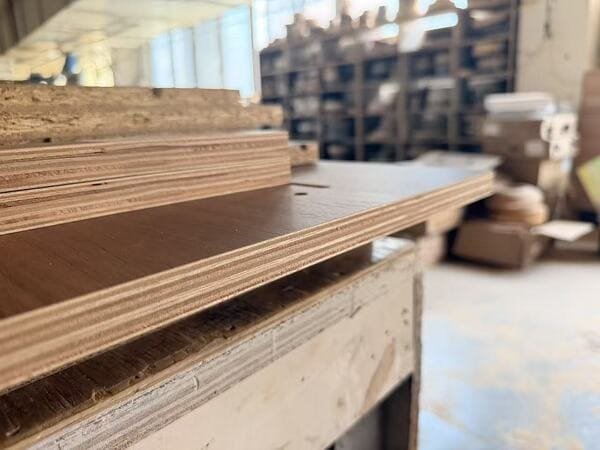
Internal Structure and Core Integrity
We should not only look at the number of plies. We also need to check whether each veneer layer is continuous, whether the veneer thickness is consistent, and whether the layup is reasonably balanced.
Open gaps, overlapping veneers, or voids may occur in the core and affect the integrity of the panel cross-section. When these defects are large or located in unsuitable positions, they may also increase the difficulty of cutting, edge banding, and drilling.
Because plywood is made from natural wood veneers, the core does not need to be completely free from defects. China’s GB/T 9846—20151 and the American ANSI/HPVA HP-1—20242 both set grades or allowable limits for core defects. The Chinese standard does not allow blistering and delamination within the specified quality requirements. The American standard limits the sizes of holes and openings according to inner-ply grades and uses separate bonding tests to evaluate the connection between layers.
Dimensional Accuracy and Flatness
The nominal thickness does not mean that the thickness is exactly the same at every position. We need to pay particular attention to thickness and flatness. Thickness variation may affect grooving, edge-banding settings, and assembly accuracy, while poor flatness may affect surface lamination and cabinet installation.
Allowable tolerances are not exactly the same in different regions. For example, for 18 mm sanded plywood, both China’s GB/T 9846—20151 and Europe’s EN 315:20003 specify that the thickness variation within one panel should not exceed 0.6 mm. The Chinese standard also includes requirements for overall panel flatness, while European and North American standards focus more on thickness, squareness, and edge straightness.
Bonding Performance
In our previous article, we mentioned that plywood is made by applying adhesive to veneers and pressing them under heat. Bonding performance determines whether the panel can remain stable during processing and use. Poor bonding may appear as edge opening, blistering, or delamination. These problems may become more visible after exposure to moisture, changes in temperature and humidity, or mechanical stress during processing.
When the material arrives, checking the panel edges may reveal some visible bond failure or delamination. However, this cannot be used to determine the actual bond strength. Whether the plywood meets the required standard still needs to be confirmed through sampling and testing according to the relevant standard.
Formaldehyde Emissions
Formaldehyde emissions relate to indoor safety and target-market compliance. They are also an important item that buyers usually need to verify. Odor alone, or E0 and ENF grades stated verbally by a supplier, cannot confirm whether the actual product meets the required limit.
Testing methods and limits are also different between regions. Therefore, when purchasing plywood, buyers should first confirm the requirements of the target market. They should then review the applicable standard, panel manufacturer, product specification, and scope stated in the test report or compliance documents to ensure that the documents cover the plywood actually used in the order.
How We Inspect Plywood During Cabinet Production
The following section explains what we inspect when plywood arrives at our factory and what we check again after cutting, based on our actual production process.
Thickness Verification
For standard panels that will be cut again, length and width are not usually the first items we verify, provided that they meet the order dimensions and cutting-layout requirements. In comparison, actual thickness has a more direct effect on the following production processes.
For an 18 mm plywood panel, we use a caliper to measure three points along the same edge: two corner points and one center point. This allows us to quickly check whether the thickness is within a reasonable tolerance range. In the measurement records for this batch of 18 mm plywood, the minimum value was 17.7 mm and the maximum value was 18.1 mm. This is a quick verification method we use before processing to identify obvious thickness differences. It does not replace the complete sampling and inspection methods required by the relevant standard.
After the plywood has been cut, we measure its thickness again using the same method. Before edge banding, we adjust the pressure-beam height of the edge-banding machine according to the measured panel thickness so that the panel receives suitable pressure during processing.
Checking the Core Structure After Cutting
Some plywood panels may appear to have an orderly core when viewed from the original panel edge, and their overall thickness may also be within a reasonable range. However, the internal condition exposed after cutting may still be different. The following comparison uses actual photos from our factory.
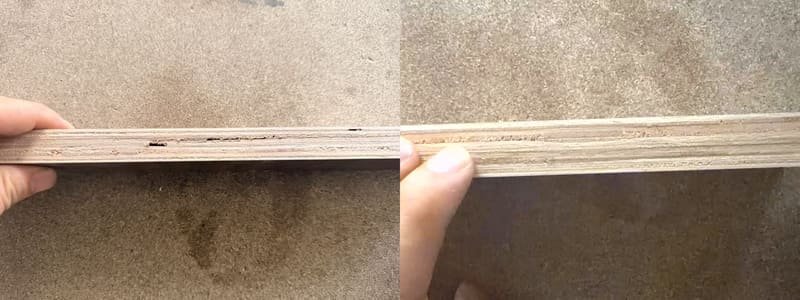
The left panel shows voids and open joints after cutting. Its layup is also uneven, and some areas contain overlapping veneers.
The right panel does not show obvious voids or open joints, but its layup is still uneven. Some veneers have noticeably different thicknesses, and overlapping veneers are also present.
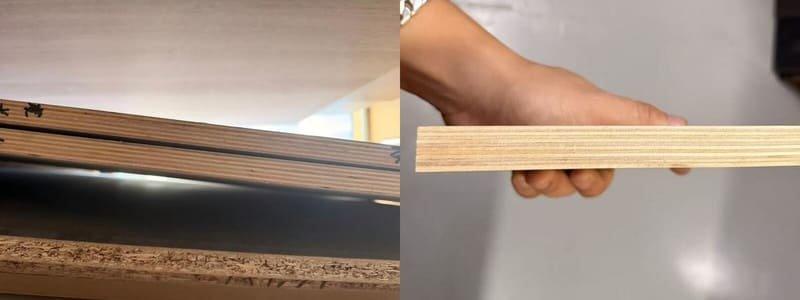
Based on the visible cut cross-sections, the cores of these two groups are in better condition. The layup is orderly, the individual layers are clear, and the veneer thicknesses are relatively consistent. There are no obvious voids or open joints, and the cut edges do not show obvious chipping or rough fibers.
It should be noted that a cut cross-section only shows the internal condition at that particular position. It cannot independently represent the entire panel or the complete production batch.
Which Quality Issues Can Be Evaluated On Site, and Which Require Testing?
For plywood thickness and visible core structure, we normally carry out on-site inspections at the following two stages:
1. When the plywood arrives
- Use a caliper to perform a quick thickness verification;
- Observe the core structure from the panel edge;
- Check for visible bonding problems, blistering, or delamination.
2. After cutting
- Measure the thickness of the cut panel components again;
- Check the cut cross-section for voids, open joints, or overlapping veneers;
- Check the cut edges for obvious chipping or rough fibers.
Moisture content can be screened on site with a suitable instrument, but formal evaluation should still follow the method specified in the relevant standard. Bond strength and formaldehyde emissions cannot be determined through visual inspection alone. They need to be confirmed through test results or valid compliance documents.
Final Notes
Plywood quality cannot be judged by only one indicator, and it cannot be fully evaluated through on-site observation alone. On-site inspection and laboratory testing need to be used together.
For custom cabinetry, Horace Home’s final consideration is not only the grade name of the plywood, but whether it can meet the specific requirements for edge banding, surface finishes, drilling, cabinet structure, and the target market.