

In the previous article, we explained how to check the edge banding quality of custom cabinets and which signs may indicate a problem. Both the edge banding material and the adhesive affect the final result. The adhesive affects not only the appearance of the glue line, but also the bonding stability between the edge banding and the panel.
When we plan to use a PUR edge banding adhesive, we cannot make the decision based only on its brand, origin, or price. Before using it in batch production, we make samples with the current panel, edge banding, and equipment. We then carry out internal tests to confirm whether these materials work well together.
Why Do We Test Samples Before Selecting a PUR Edge Banding Adhesive?
When selecting a PUR edge banding adhesive, we consider its technical information, application experience, and cost. Established brands usually provide more complete technical documents and application support. However, imported products often have a higher purchase cost. For orders where cost control is important, we also evaluate PUR adhesives made in China.
However, a suitable price does not mean that the adhesive can be used directly in production. When testing a brand that we have not used before, we do not rely only on the supplier’s description. We also do not judge it only by the appearance of a newly edge-banded sample. We first make samples using the panels, edge banding, and equipment currently used in our factory.
We do this because the final edge banding result does not depend only on the adhesive. The condition of the panel edge, the primer on the back of the edge banding, the machine temperature, and the glue application can all affect the final bond. The same adhesive may perform differently when used with different materials or equipment.
The purpose of the test is not to prove that a PUR adhesive will never fail under any condition. It helps us decide whether the adhesive is stable enough with the current panel, edge banding, and equipment, and whether it is suitable for further production.
Which Materials and Processing Conditions Should Be Confirmed Before Testing?
Before testing a PUR edge banding adhesive, we first confirm the materials and equipment conditions. Changing only one of these conditions may produce a different result.
We make several samples using the same materials and processing conditions. Separate samples are used for the initial bonding, peeling after storage, heat, low temperature, and water immersion checks. This prevents one test from affecting the result of another test.
Before testing, we keep the following conditions as consistent as possible:
| Test item | Conditions used in this test |
|---|---|
| Edge banding equipment | PUR edge banding machine |
| Test substrate | Particleboard with relatively stable quality |
| Edge banding | 1 mm PVC edge banding |
| Adhesive | PUR edge banding adhesive made in China and under evaluation |
| Machine temperature setting | Set within the application temperature range recommended by the supplier |
| Storage time before rechecking | 48 to 72 hours |
| Test type | Internal factory material screening |
We use particleboard as the test substrate because it makes the peeling result easier to observe. After peeling, we can see how much particleboard material remains attached to the back of the edge banding.
Plywood has a stronger layered structure. If the bond is strong, the PVC edge banding may break first during peeling. This makes it more difficult to observe the bonding condition between the adhesive and the substrate.
The panel and edge banding used for the test also need to have relatively stable quality. If the PVC edge banding has poor flexibility, it may break quickly during peeling. In that case, it becomes difficult to continue judging the adhesive. If the panel edge is too loose, the result may mainly reflect a problem with the panel itself.
Step 1: Check the Glue Application Without Feeding the Edge Banding
At the beginning of the test, we do not feed the edge banding into the machine. We first set the machine within the application temperature range recommended by the supplier.
For the adhesive and equipment used in this test, we usually set the machine to 145°C in summer and 150°C in winter. We then allow the panel to pass only through the glue application section. Before the edge banding is pressed onto the panel, we remove the sample and directly check the glue layer on the panel edge.
This allows us to see the glue application condition clearly. If the edge banding is installed from the beginning, it covers the glue layer. If unstable bonding is found later, it becomes more difficult to identify whether the cause is the adhesive, the glue application, or the pressing process.
We mainly check:
- Whether the glue layer has an even thickness
- Whether the glue is applied continuously without missing sections
- Whether there are visible air bubbles
- Whether the adhesive forms consistent strings and flows steadily around the glue roller
We pay particular attention to the stringing around the glue roller. Continuous stringing and even flow indicate that the adhesive can be applied normally at the current temperature. If the strings suddenly become thick, thin, or interrupted, we first check the temperature, glue roller, and glue amount. We do not immediately treat it as an adhesive quality problem.
This stage only shows whether the adhesive can be applied steadily under the current equipment conditions. It does not show the final bonding strength. After confirming that there are no obvious missing areas, bubbles, or uneven glue thickness, we install the edge banding and check the initial bond of the sample.
Step 2: Check the Initial Bond as Soon as the Sample Leaves the Machine
After confirming that the glue application is stable, we install 1 mm PVC edge banding and use the same panel material to make a complete sample.
This time, we wait at the outlet of the edge banding machine. As soon as the sample comes out, we do not only look at whether the edge banding is attached to the panel. We immediately try to lift the edge banding by hand, especially at both ends of the panel.
We focus on the two ends because the edge banding passes through end trimming and edge trimming after pressing. These processes create some mechanical vibration. The PVC edge banding also has its own springback force. If the adhesive does not have enough initial bonding strength, the two ends may become loose first.
We mainly check:
- Whether the edge banding remains stable after end trimming and edge trimming
- Whether either end can be lifted easily by hand
- Whether the beginning or end of the edge banding has any unbonded area
If the edge banding can be lifted easily as soon as it leaves the machine, we do not immediately conclude that the adhesive is poor. We first check the pressing condition, end trimming and edge trimming tools, and whether the cooling conditions are suitable. The primer on the back of the edge banding, dust on the panel edge, and material temperature may also affect the result.
After these factors have been checked, if the edge banding still cannot withstand normal machine vibration and its own springback force, the adhesive may not have enough initial bonding strength under the current conditions.
After the samples pass the initial bonding check, we keep other samples for 48 to 72 hours before carrying out further checks.
Why Is a Newly Finished Sample Not the Final Result?
The check immediately after edge banding mainly shows whether the bond can withstand end trimming, edge trimming, and the springback force of the edge banding. If the two ends do not lift and the edge banding cannot be opened easily, the initial bond can generally meet the normal processing requirements.
However, PUR adhesive continues to react and cure with moisture from the air or the substrate after pressing1. The newly finished sample shows the initial bond. The peeling check after 48 to 72 hours is used to observe the bonding condition after further curing.
For this reason, we do not decide whether to use the adhesive in batch production only by looking at the newly finished sample. The initial bond and the bonding condition after storage show different things. One result cannot replace the other.
Step 3: Carry Out a Peeling Check After 48 to 72 Hours
After the initial bonding check, we keep the samples for 48 to 72 hours. We then check the bonding condition after the PUR adhesive has cured further.
At this stage, we do not only try to lift the edge banding by hand. After the set storage period, the edge banding is usually difficult to lift directly from the panel edge.
We first use a utility knife to separate about 3 cm of the edge banding from one end. We then hold the separated section with pliers and continue pulling it along the panel edge. We try to remove the full strip of edge banding.
During this process, we observe three main points.
The first is the resistance during pulling. This manual check does not use force measurement equipment, so it cannot provide an accurate peel strength value. However, the difference in resistance between samples is usually easy to feel. If the edge banding can be pulled off continuously with little resistance, we need to further check the compatibility of the adhesive, the primer on the edge banding, and the panel edge.
The second is the surface condition after peeling. We check whether particleboard material remains attached to the back of the edge banding and whether the attached particles are continuous. If a large amount of particleboard material is pulled away with the edge banding, more of the failure has occurred inside the panel instead of directly between the adhesive and the panel or edge banding surface.
The third is the condition of the edge banding itself. Some lower quality PVC edge banding has poor flexibility and may break during peeling. In this situation, we cannot judge that the adhesive is strong only because the edge banding breaks. The result may also be affected by the quality of the edge banding itself.
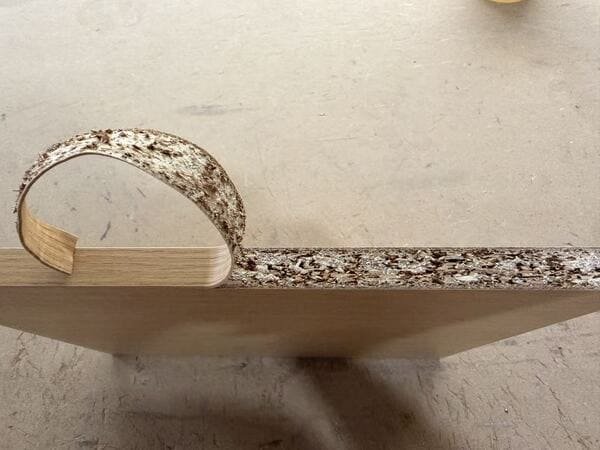
During our internal comparison, we use the amount of particleboard material attached to the back of the edge banding as an important reference. If about 80% or more of the surface is covered with particleboard material, we normally consider the bonding condition of the sample to be relatively strong.
However, this percentage is an internal observation used for comparison in our factory. It is not a general industry acceptance standard. It also cannot be converted into a standard peel strength value in N/mm.
Step 4: Carry Out Heat and Low-Temperature Checks After the Set Storage Period
Cabinets may face high or low temperatures during transportation, storage, or use. For this reason, we do not only check the bond at normal room temperature.
After the normal peeling check, we use other samples made under the same conditions and stored for the same period. These samples are used for heat and low-temperature checks.
Heat Check
During the heat check, we hold a hot air gun about 30 cm away from the sample. We move it back and forth over the edge banding area about seven to eight times.
After heating, we do not immediately try to lift the edge banding. We first allow the sample to cool naturally. We then inspect the glue line and edge banding.
We mainly check:
- Whether the glue line becomes visibly soft
- Whether adhesive flows out from the glue line
- Whether the edge banding springs back after heating
- Whether the glue line develops local separation or cracking
- Whether the edge banding remains stable after cooling
Reactive PUR hot melt adhesive forms a crosslinked structure during further curing. This usually helps improve the stability of the adhesive under heat2. However, different products have different formulations and heat resistance ranges.
Low-Temperature Check
For the low-temperature check, we place the sample in a freezer for about one day. After removing it, we first check whether there are any visible changes in the glue line or edge banding. We then carry out a manual peeling check to observe the flexibility of the adhesive layer.
We mainly check:
- Whether the adhesive layer becomes noticeably brittle
- Whether the edge banding can be removed as one complete strip
- Whether there is still clear resistance during peeling
- Whether the adhesive layer keeps some flexibility and toughness
If the sample loses flexibility after low-temperature storage, continuous separation may occur during peeling. A more stable sample still provides some resistance and continues to pull away some particleboard material.
The purpose of the heat and low-temperature checks is not to prove that a PUR adhesive can perform under every climate condition. The purpose is to observe whether the glue line becomes soft, brittle, separated, or otherwise unstable after a clear temperature change.
Step 5: Use Water Immersion to Observe the Water Resistance of the Glue Line
The water immersion check also uses a separate sample made under the same conditions and stored for the set period.
After further curing, reactive PUR hot melt adhesive usually has relatively good resistance to moisture2. However, its actual performance still depends on the adhesive formulation, curing conditions, and material combination. Using PUR adhesive also does not mean that the panel cannot absorb water or swell.
For this check, we place the edge banding sample in water for about one day. After removing it, we wipe away the surface water and separately inspect the glue line, edge banding, and panel edge.
We mainly check:
- Whether the glue line becomes white or noticeably soft
- Whether the edge banding lifts or separates locally
- Whether the edge banding becomes easier to peel after immersion
- Whether the panel edge shows visible swelling
The glue line and panel need to be evaluated separately. Even if the glue line remains stable after immersion, particleboard may absorb water through an exposed area, cut, or damaged surface.
Panel swelling does not always mean that the PUR adhesive has failed. In the same way, no visible change on the panel surface does not by itself prove that the glue line has sufficient water resistance.
We focus more on whether the adhesive layer becomes white, soft, or clearly separated after immersion. If the edge banding is still difficult to peel and particleboard material is still pulled away with it, we have not observed obvious bonding failure after this water immersion check.
What Can These Internal Tests Show?
After completing the tests, we use the results to decide whether the PUR adhesive is suitable for the current panel, edge banding, and equipment conditions, and whether this combination can move to the next production stage.
If one test shows an abnormal result, we adjust the equipment settings or change the material and make new samples. We continue using the combination only after the results are relatively stable.
These tests are used for internal factory screening. They cannot replace third-party laboratory testing, and they cannot prove that the edge banding will never fail under every condition. However, they can help us identify clearly unstable material combinations before production and provide a basis for later material selection.
Final Notes
The brand, price, and technical information of a PUR edge banding adhesive can be used as references, but they cannot replace actual testing. For a factory, it is more important to confirm whether the adhesive is compatible with the current panel, edge banding, and equipment conditions.
For custom cabinet orders using PUR edge banding adhesive, Horace Home confirms the edge banding solution according to the actual panel, edge banding material, and intended use. When the material or processing conditions change, new samples are made instead of directly applying the results of a previous test.