

White oak veneer has a light color and clear wood grain. After a clear or light-colored finish, it can keep the natural look and texture of real wood. So it is also one of the veneer finishes we often use in our factory.
However, during the processing of white oak veneer, a surface problem can sometimes appear quite suddenly. The veneer may look normal right after it is applied. A few hours later, small blue-black or gray-black spots may start to appear. These dark areas may then become more obvious along the wood grain.
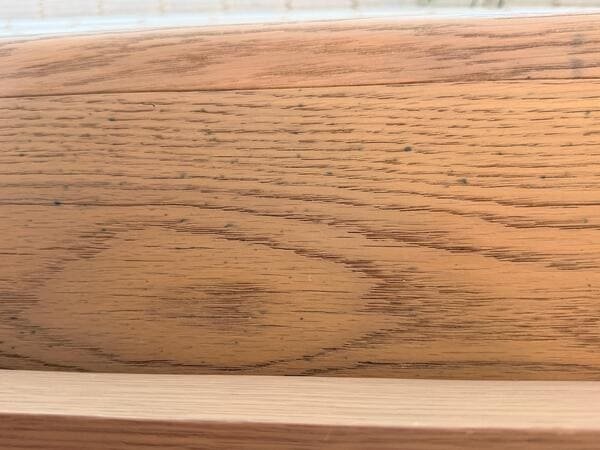
This can easily be mistaken for mold, poor veneer quality, or simply "white oak turns black after getting wet." In fact, one cause that needs to be checked is a reaction between iron contamination and the tannin-like extractives in white oak.
We actually had this problem when producing a batch of white oak veneer cabinets in our factory. So in this article, we will use this case to look at how the iron-tannin reaction happened, how we checked the problem step by step, and what we changed when we remade the panels.
What Are Tannins?
Tannins are one type of natural extractive found in wood1. They are polyphenolic compounds. Oak contains a relatively high amount of tannin-like extractives.
They are not a "quality defect." They are part of the natural chemical composition of wood. Wood extractives can also affect the color, smell, and natural durability of wood.
For white oak processing, we are more concerned about another characteristic of tannins: when they come into contact with iron, they can produce a very noticeable dark reaction.
This is why, when processing solid white oak or white oak veneer, ordinary steel tools, iron particles, and other possible sources of iron contamination all need attention.
Why Can Iron Turn White Oak Veneer Black?
I reviewed some public information on this topic. Tannin-like extractives in wood can react chemically with iron and may produce blue-black or gray-black discoloration. Oak contains relatively high levels of tannin-like extractives, so it is especially prone to this type of reaction2.
There is also one point that can easily cause confusion.
If black spots start to appear after white oak veneer is sprayed with water or wiped with a damp cloth, many people may naturally think:
"White oak turns black when it gets wet."
But this is not accurate.
In an iron-tannin reaction, water itself is not the only cause of the dark color. More importantly, moisture helps the wood extractives and iron move, come into contact, and react.
So this problem should not simply be understood as "white oak turns black after getting wet." In this case, we needed to check three things together: the tannin-like extractives in the wood, the source of iron contamination, and the moisture conditions.
That is why we did not only check the water-spraying step. We started looking for another answer: after the veneer became wet, where could it have come into contact with iron?
When Did Black Spots Start to Appear on This Batch of White Oak Veneer?
Some parts in this batch had shaped surfaces. So, similar to the hand veneering method introduced in our previous article, we used 0.3 mm white oak veneer and applied it by hand. The substrate was plywood.
Before veneering, we prepared and leveled the substrate. The veneer was lightly dampened, adhesive was applied, and a special veneer iron was used to bond it with heat.
Right after veneering, the surface looked normal. But a few hours later, we started to see some very small blue-black spots. At that time, they were scattered and not very obvious.
By the next day, the situation had changed. The original blue-black spots became darker, and some of the dark areas started to spread along the white oak grain. At this point, we were fairly sure that this was not normal natural color variation.
At first, we also suspected the water spray. But if the problem was simply caused by "the veneer getting wet," it would be difficult to explain why some areas became obviously dark while nearby areas did not.
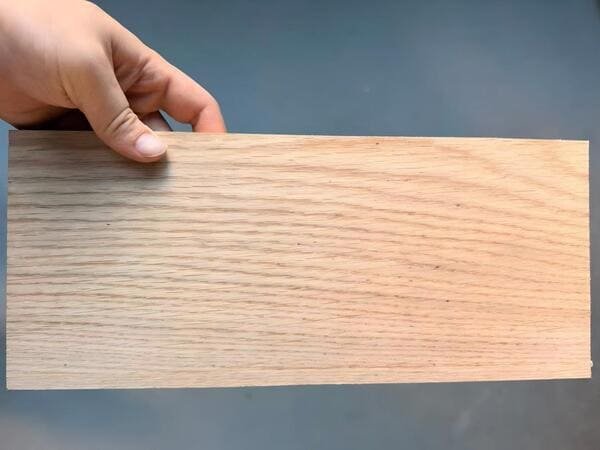
So we took a piece of white oak veneer that already had a few small blue spots and continued testing.
Does Water Alone Turn White Oak Veneer Black?
We first tested the effect of water alone.
The outdoor temperature was about 38°C. We wet a piece of white oak veneer that already had a few small blue spots and left it to dry naturally.
After about 30 minutes, the veneer was mostly dry.
We observed that the existing blue spots became slightly more noticeable, but we did not see the same obvious spread of blue-black discoloration that had appeared the previous day.
This test cannot prove that "white oak will never show any color change after contact with water." This was not a controlled laboratory test, and the veneer already had a small amount of blue spotting before the test.
But under these test conditions, we did not see water alone quickly create a large number of new black spots.
So our investigation moved to another question:
Where was the iron coming from?
What Happened When Wet White Oak Veneer Touched a Steel Blade?
Next, we wet the same type of white oak veneer again.
This time, we added a clear source of steel contact: an ordinary utility knife blade.
We placed the blade directly on the wet veneer without any other treatment. After about 10 minutes, the surface was still not completely dry, but a clear dark reaction had already appeared where the blade touched the veneer.
After removing the blade, the contact area had already turned noticeably blue-black.
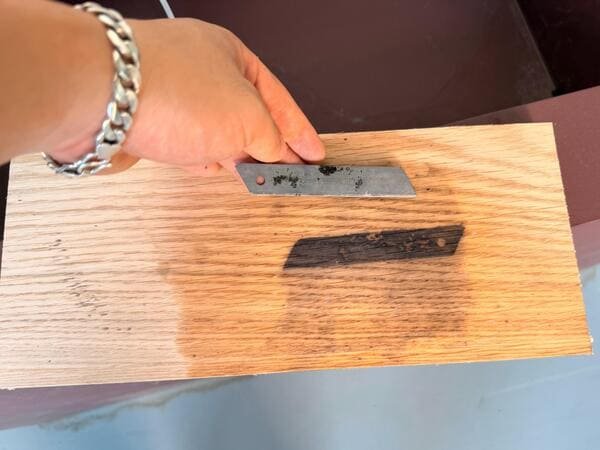
With water alone, we did not see a large number of new black spots. But when the wet veneer touched an ordinary steel blade, the contact area became clearly dark after about 10 minutes.
For this batch of 0.3 mm white oak veneer, this was enough for us to shift our investigation toward possible iron contamination during production.
Can Oxalic Acid Remove These Blue-Black Stains?
After identifying iron as an important direction to investigate, we continued testing whether the existing blue-black spots could be treated.
We wore gloves and used a clean cloth with a small amount of oxalic acid to wipe the dark areas. After a few seconds to around ten seconds, the visible blue-black color started to fade. Some areas returned to a color close to the original veneer.
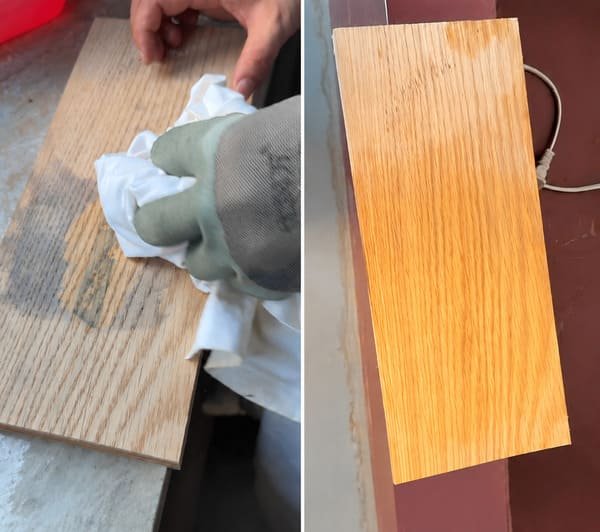
This result was generally consistent with the public information we found.
After treatment, the area still needs to be cleaned, and the source of iron contamination also needs to be removed. Otherwise, the discoloration may appear again3.
So we did not assume that the problem was solved just because the black spots disappeared.
Why Did Our First Treatment Cause Another Color Change?
Based on the earlier tests, we made our first attempt to treat the affected white oak veneer.
We first used oxalic acid to remove the black spots, then wiped the treated area with a damp cloth. To dry the veneer faster, we used a heat gun.
This created another problem.
After the hot air reached the veneer, the treated area quickly became darker again. The color looked slightly like wood that had been darkened by higher heat.
At first, we suspected the metal nozzle of the heat gun because the veneer was still wet. But looking back, too many variables were introduced at the same time. There was still oxalic acid and moisture on the veneer, and we also added local heat, a metal nozzle, and strong airflow.
So we could not directly say that the darker color was caused by the metal nozzle.
Later, we tested another area.
This time, after wiping with oxalic acid, we did not use the heat gun. We first used a clean dry cloth to absorb the surface moisture and then allowed the veneer to dry naturally.
After drying, the surface result was much more stable.
So we stopped using the heat gun for this drying step.
Why Did We Stop Repairing the Veneer and Remake It Instead?
Although oxalic acid could make the blue-black stains fade quickly, we finally decided not to continue using this batch of visibly affected veneer.
Some areas only had newly formed blue spots, and the visible color faded quickly after oxalic acid treatment. But in other areas, the dark color had already spread along the grain after one day.
At that point, it was difficult for us to confirm that the contamination and reaction had been completely removed just because the surface looked normal again.
The veneer still needed further sanding and finishing. If some iron contamination remained, later exposure to moisture could cause the discoloration to appear again.
Clear or light-colored white oak finishes keep the natural grain visible. Any local color difference would also remain visible on the final surface.
So we decided not to take the risk. We rejected the affected veneer and used new white oak veneer to remake the parts.
For us, the main value of the oxalic acid test was to help investigate and confirm the problem. It was not a way to repair clearly contaminated veneer and continue using it for the final product.
What Did We Change When We Remade the Veneer?
After identifying the likely problem, we started again with a new batch of white oak veneer.
This time, we did not only change the water-spraying step. We checked the whole veneering process again for possible sources of iron contamination.
Keep the white oak veneering area away from other processes where possible
We first changed the location of the veneering work.
Cutting, sanding, and other processing areas already have more dust and tool activity. If particles from tool wear, metalworking, or other iron-containing sources are mixed into this environment, they may increase the risk of contaminating the veneer.
We cannot say that every airborne dust particle will cause a visible reaction. But since this batch of wet white oak veneer showed a clear sensitivity to ordinary steel contact, there was no reason to keep adding unnecessary contamination risks.
So during the remake, we kept the white oak veneering work away from these processes as much as possible.
Add PTFE high-temperature cloth over the iron base
During hand veneering, we use a special iron to apply heat.
The metal base of the iron originally touched the veneer directly. During the remake, we added a layer of PTFE high-temperature cloth over the base to separate the metal surface from the white oak veneer.
We cannot confirm that the iron base was the source of the original problem. But since this was a relatively large metal contact surface and could be isolated easily, we removed this possible risk.
Use stainless steel tools for trimming
The veneer still needs trimming after it is applied.
During the remake, we replaced the ordinary steel trimming tool with a stainless steel trimming knife. Stainless steel is still an iron-based alloy, but under normal conditions it has better corrosion resistance than ordinary carbon steel.
Our goal was not to find a tool that contains "no iron at all." It was to reduce the chance of contamination from ordinary steel and rust.
Use hard plastic tools where metal is not necessary
For some pressing and finishing operations that did not require a cutting tool, we changed to a hard plastic scraper.
The change was simple. If a step does not require a metal tool, there is no need to create another metal contact point on wet white oak veneer.
Stop using a heat gun for forced drying
The earlier treatment test showed us that the heat gun introduced too many new variables at the same time. So during the remake, we did not use it to speed up drying.
When surface moisture needed to be removed, we first used a clean cloth to absorb it and then allowed the veneer to dry naturally.
After these changes, we completed the white oak veneering again.
What Do We Check When Producing White Oak Veneer Now?
After this problem, we now pay extra attention to several points when working with white oak veneer:
- Whether wet white oak veneer directly touches ordinary steel tools;
- Whether the iron, scraper, and trimming tools can be used in a way that reduces direct metal contact;
- Whether cutting, sanding, or other processes that may create metal-containing dust are happening near the veneering area;
- Whether wetting, damp wiping, or later finishing steps introduce any new source of iron contamination;
- Whether the wood surfaces that need sealing are properly sealed according to the actual finishing system.
The last point needs to be separated from the iron contamination issue. Sealing does not replace iron contamination control. For white oak veneer, we treat sealing as part of the later surface protection, but the source of iron contamination still needs to be addressed first.
Final Notes
This white oak veneer staining problem did not make us stop using water during veneering. What changed was how we control possible sources of iron contamination during the process. Even a small area of metal contact can leave a very visible result on wet white oak.
At Horace Home, when we see this type of surface problem, we prefer to find the cause first and then decide whether production should continue. If we cannot confirm the long-term stability of the veneer, remaking it is usually more reliable than making the surface look temporarily acceptable.