

Cabinets with wood veneer finishes can look very different. Some have clear cathedral grain with more variation. Some have quieter and more regular straight grain. Many are somewhere between these two.
For custom cabinetry, the wood species only gives us a basic direction. The final grain also depends on the natural wood, veneer cut, veneer selection, matching, and overall layout.
In actual communication, most clients describe the grain look they want instead of asking for a specific veneer cut. So we usually first understand the look the client wants, then confirm it step by step with reference images, actual veneer, and samples.
Below, we will use white oak veneer as an example to explain why cathedral grain and straight grain look different, and how to choose between them for custom cabinetry.
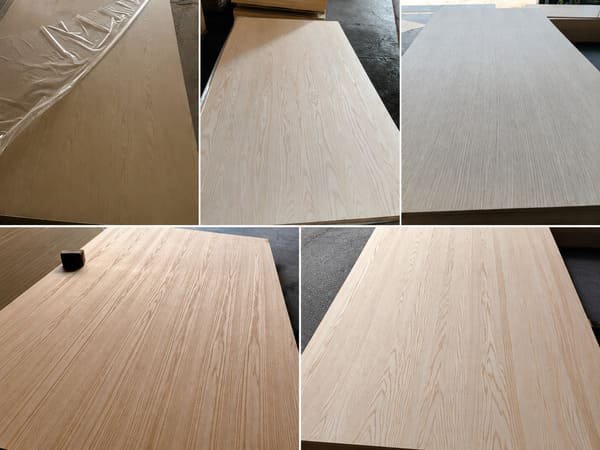
Why Can White Oak Veneer Cabinets Have Very Different Grain Patterns?
“White oak veneer” tells us the wood species, but it does not fully define the final grain.
Some white oak veneers have clear cathedral grain. Some are mainly straight grain. Some have both cathedral and straighter grain areas.
This first comes from the natural wood itself. The growth rings, the position where the veneer is cut from the log, and the cutting direction can all change the grain pattern.
When the veneer is used on cabinetry, we also need to consider how these veneer leaves will form the complete visible surface.
If one veneer leaf is wide enough, it can cover the required surface by itself. If several veneer leaves are needed, veneer selection, trimming, arrangement, and matching will also affect the final result.
So we usually look at the grain in two parts:
- The grain of each veneer leaf: This mainly depends on the natural wood structure and veneer cut.
- The final look of the whole cabinet door: This also depends on veneer selection, veneer matching, and the overall layout.
Based on public architectural woodworking standards, confirming only the wood species is not enough to fully define the final veneer appearance. The veneer cut and matching method also need to be considered separately1.
When Clients Say “Calm, Natural, and Not Too Repetitive,” What Do They Mean?
In the projects we work on, professional designers sometimes ask for cathedral grain, straight grain, or a specific veneer cut. But more clients first describe the look they want:
“The grain should look calmer,” “not too busy,” “not too repetitive,” “it should look natural,” or “I want a cleaner overall look.”
These descriptions are useful, but they are not complete veneer specifications.
For example, two clients may both ask for a “calm” grain. One may not like large cathedral patterns. Another may simply not want one cabinet door to look much more active than the others.
So we usually also ask the client to provide reference images. Compared with words such as “calm,” “cathedral grain,” or “straight grain,” an image makes it easier for both sides to confirm whether we are talking about the same look.
What Is the Difference Between Cathedral Grain and Straight Grain in White Oak Veneer?
The veneer cut has a clear effect on the basic grain of each veneer leaf.
| Desired Look | Common Veneer Cut | Typical Look in White Oak |
|---|---|---|
| Clear cathedral grain with more visual variation | Plain sliced | More likely to show cathedral grain |
| Straight grain with more visible wood rays | Quarter sliced | Mainly straight grain, with possible visible ray fleck |
| More even and calm straight grain | Rift cut / rift sliced | Mainly straight grain, usually with less visible ray fleck |
Cathedral Grain
Cathedral grain usually appears as V-shaped, U-shaped, or arch-shaped patterns.
On cabinet doors, cathedral grain usually attracts more attention. The width, position, and shape of the cathedral pattern can also change from one veneer leaf to another, so a row of cabinet doors may look more active.
This variation is not a quality problem by itself. If the design is meant to show more of the natural wood grain, cathedral grain can become part of the cabinet appearance.
Straight Grain
Straight grain mainly appears as lines running in one direction.
Compared with clear cathedral grain, straight grain usually looks quieter and more regular. This is why it is often used on tall cabinet doors, wardrobe walls, or large veneer surfaces.
However, “straight grain” is still not a complete specification.
As shown in the table above, both quarter-sliced and rift-cut veneer can produce straight grain. But the cutting angles are different, so the final grain is also different.
For white oak, one of the easiest differences to see is the amount of visible ray fleck. Quarter-sliced white oak usually shows more obvious wood rays. Rift-cut white oak usually has less visible ray fleck and a more even grain2.
These flake-like or angled markings come from the natural structure of white oak. They are not veneer defects.
So if a client only says:
“I want straight-grain white oak.”
We usually still need to confirm:
Do they accept visible ray fleck? How much natural variation do they want in the straight grain?
You may also often see the term “rift-sawn white oak cabinets” in the market. If the cabinet doors are actually made with veneer-faced panels, “rift-cut white oak veneer” is a more accurate way to describe the surface material.
Why Do Veneer Selection and Matching Also Change the Cabinet Door Appearance?
The veneer cut affects each veneer leaf, but the final cabinet door also depends on how the veneer is selected and combined.
Common veneer matching methods include3:
- Book Match: Adjacent veneer leaves are flipped alternately, which can create a mirrored grain pattern.
- Slip Match: Consecutive veneer leaves are placed with the same face and in the same direction.
- Plank Match: Different veneer leaves can keep more visible differences in color, grain, or width, giving a look closer to naturally joined solid wood boards.
In the Chinese veneer supply chain, suppliers may also use terms for same-direction matching, alternating-face matching, solid-wood-style matching, or mixed cathedral-and-straight-grain matching.
These names are useful in communication, but different veneer suppliers may use them in different ways. So we do not judge the final look only by the name of a matching method. What matters more is how the actual veneer is selected, arranged, and matched, and what the complete visible surface looks like.
The same applies to terms such as “large cathedral grain,” “small cathedral grain,” “partial cathedral grain,” and “straight grain.” They are mainly used to describe the grain look:
- Large cathedral grain: Wider and more obvious cathedral patterns.
- Small cathedral grain: Narrower and more restrained cathedral patterns.
- Partial cathedral grain: Only part of the cathedral pattern is visible.
- Straight grain: Mainly linear grain.
These are common visual descriptions in the Chinese veneer supply chain. They are not a unified international classification of veneer cuts.
They can help us narrow down the direction, but they cannot fully define what the final cabinet door will look like.
How Do We Turn the Client’s Desired “Look” Into an Actual Veneer Effect?
When confirming veneer with a client, I usually do not ask them to choose from a long list of professional veneer terms first. We first confirm the wood species, then look at how they want the finished cabinetry to look.
Our normal process has four main steps.
Step 1: Confirm the Wood Species
First, we confirm the wood species.
For example, if the client chooses white oak veneer, this only confirms the basic material. It does not confirm the final grain yet.
Step 2: Confirm the Visual Direction
Professional clients may directly ask for cathedral grain, straight grain, or a specific veneer cut.
More often, we receive descriptions such as “calmer,” “not too busy,” “not too repetitive,” or “keep the natural wood look.”
If the client can also provide one or more reference images, it is easier for us to understand what they want.
Step 3: Find the Actual Veneer
After confirming the wood species and general visual direction, we communicate the client’s description and reference images to the veneer supplier.
We then look for actual available veneer that is close to the required look.
Once we find a suitable option, we usually take photos of the actual veneer and send them to the client to confirm the direction.
If the direction is not right, we adjust it before formal production.
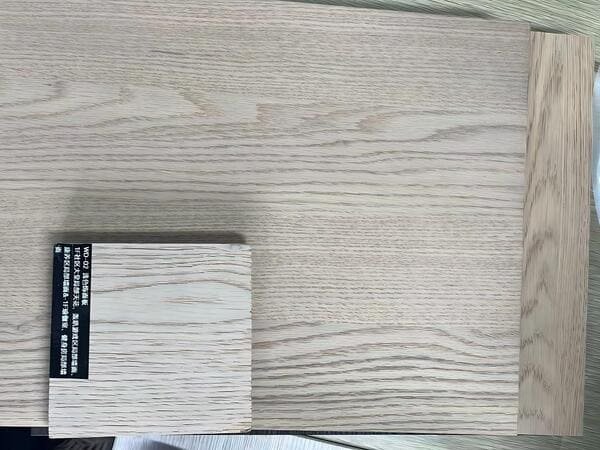
Step 4: Make an Approx. 300 × 400 mm Sample
After the client confirms the veneer direction, we usually make an actual sample of about 300 × 400 mm.
This is a sample size commonly used by Horace Home. It is not a standard size required by the veneer industry.
The sample is mainly used to confirm:
- The main grain features within the sample area;
- Grain direction;
- The color of the actual veneer after finishing;
- The overall appearance.
The sample becomes a visual reference for the later visible surfaces. It does not mean that every cabinet door must have exactly the same grain pattern.
Why Do Tall Cabinet Doors and Large Cabinet Walls Need a Wider Grain Range to Be Confirmed?
A 300 × 400 mm sample can confirm the main grain direction, but it cannot fully represent a cabinet door more than two meters high or a full wall made from many cabinet doors.
As the visible veneer area becomes larger, more natural variation can appear, such as:
- Changes in the width and position of cathedral grain;
- Differences in grain width between veneer leaves;
- More visible ray fleck in some areas;
- Natural color variation.
However, “natural veneer has variation” does not mean that every variation should be accepted.
If the client has already specified rift-cut veneer or another defined grain range, we still need to select veneer within the confirmed material and visual limits. Obvious cathedral grain should not be mixed in if it is outside the agreed direction.
For tall cabinet doors, long doors, or large cabinet walls, we may also:
- Provide more photos of the actual veneer planned for use;
- Discuss the acceptable variation between veneer leaves;
- Increase the number of samples;
- Or increase the sample size based on the client’s requirements.
The main question at this stage is not whether every cabinet door can look exactly like the small sample.
It is whether the larger surface still stays within the confirmed grain direction and acceptable variation range.
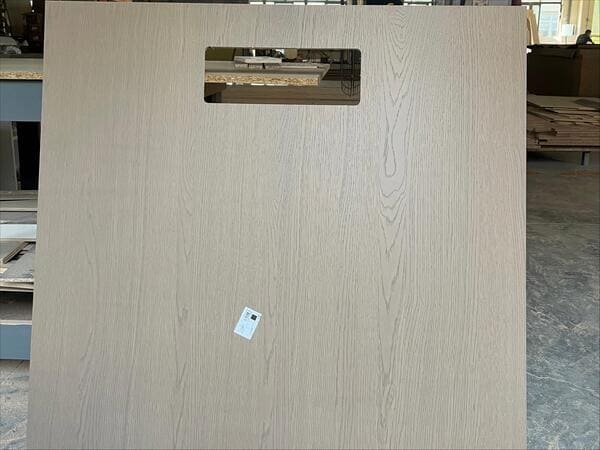
If the project also requires continuous grain between adjacent cabinet doors, this will involve grain matching and cabinet door layout. We discussed this in our previous article about wood veneer cabinet door specifications, so we will not repeat it here.
Final Notes
For wood veneer cabinetry, terms such as “cathedral grain,” “straight grain,” “calm,” or “natural” can help define the direction, but no single term can fully define the final look.
Natural veneer will have variation, but this variation still needs to stay within the confirmed material, grain direction, and visual range. For tall cabinet doors and large cabinet walls, the acceptable variation may need to be confirmed with more actual veneer.
At Horace Home, we prefer to first understand what the client wants to see, then confirm that direction through actual veneer and finished samples. The goal is not to make natural veneer look like a perfectly repeated pattern, but to make sure the client and the factory have a clear and consistent understanding before production starts.