
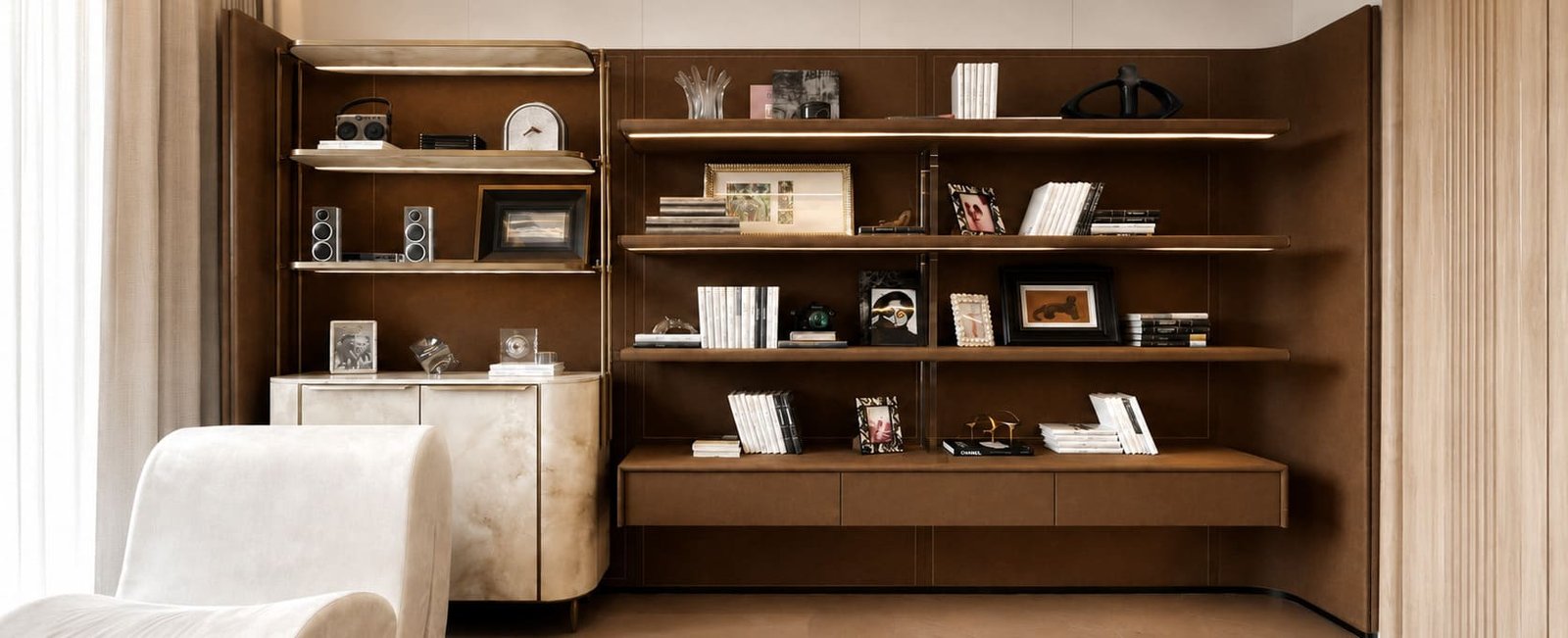
When wood veneer is used in custom cabinetry projects, some people simply assume that natural wood veneer is better and engineered veneer is only a cheaper option.
From our factory production experience, natural wood veneer and engineered veneer are not simply better or worse than each other. They are used for different visual and project needs.
In many of our projects, clients already have a material direction, a color sample, or a physical sample. Some clients directly specify natural wood veneer. Some give us a sample and ask us to use engineered veneer to achieve a similar look. In some projects, natural wood veneer and engineered veneer are even used in different areas.
The questions that cause confusion are often very simple ones: Does engineered veneer have no color variation? If an engineered veneer is called “Washed White Oak,” is it actually made from white oak? Is engineered veneer always better for a large cabinet wall?
If we only look at the material name, it is easy to reach an overly simple conclusion. In this article, we will look at these two types of veneer from actual cabinetry applications and explain the differences that really matter.
What Is the Basic Difference Between Natural Wood Veneer and Engineered Veneer?
Natural wood veneer is a thin layer of wood that is peeled or sliced directly from logs or wood blocks. It keeps the natural grain, color, and variation of the wood.
Engineered veneer is also commonly called reconstituted veneer. It is also based on real wood, but the veneer is rearranged, bonded, pressed, and sliced again to create a designed color and grain pattern. Some products may also be bleached or dyed, but the exact process is not the same for every product.
So, engineered veneer is not printed paper, a melamine finish, or a plastic wood-grain surface. It is still a wood veneer. The difference is that its color and grain can be controlled more during production.
This is the basic difference between the two materials: natural wood veneer keeps more of the original variation of the wood, while engineered veneer allows more control over the final visual effect.
If an Engineered Veneer Is Called “White Oak,” Is the Actual Wood Species Always White Oak?
For natural white oak veneer, if the material is clearly specified as natural white oak veneer, it normally means the veneer is sliced from white oak itself.
With engineered veneer, the product name is often closer to a color or design name. It mainly describes the final color and grain effect. It does not always describe the actual wood species used to make the veneer.
We have used engineered veneers with names such as “Silver Pear” and “Washed White Oak.” Suppliers normally provide the product name, code, color number, and thickness. We also confirm and order the material based on this information in their product catalog. However, for these domestic projects, the suppliers did not separately provide the actual wood species.
So, if an engineered veneer product is called “Washed White Oak,” we cannot assume from the name alone that it is made from white oak.
Based on the public information we reviewed, reconstituted veneer can use other wood species and then be recomposed to create a visual effect similar to oak, walnut, or other wood species1.
For projects that mainly focus on color and wood-grain appearance, the product code and approved sample are usually important references when we confirm the material.
However, if a project also has requirements for wood origin, wood species, or traceability, we should not rely only on a design name such as “White Oak.” In this case, the actual wood species, visual design, and product code should be confirmed separately.
What Are the Main Visual Differences Between Natural Wood Veneer and Engineered Veneer on Finished Cabinets?
If we only look at a small sample, the difference between the two materials may not always be as obvious as expected. The difference often becomes clearer when the veneer is used across a full row of cabinet doors or a large wood-paneled surface.
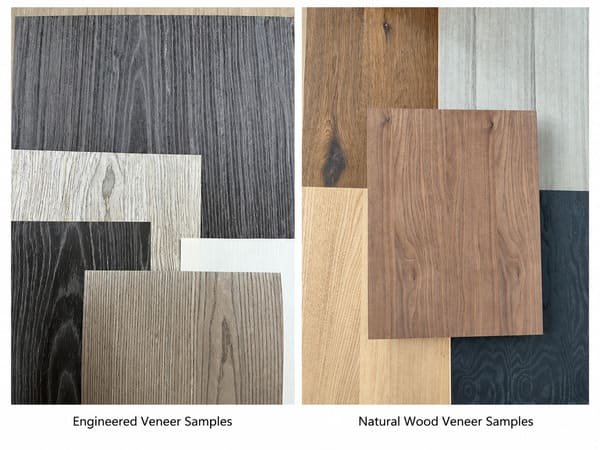
Natural wood veneer keeps the natural variation of the wood. Even within the same type of veneer, the color, grain width, and proportion of cathedral grain and straight grain can vary. For projects that want the look and feel of real wood, this variation can be part of the design.
Engineered veneer can usually keep the color and grain within a more controlled range. Because of this, the overall appearance is often easier to coordinate across a full row of cabinet doors or continuous wall panels.
However, this does not mean every sheet will look exactly the same. It also does not mean the grain must look mechanical.
We have used engineered veneer on large surfaces, and the result did not show an obvious repeated pattern like a printed surface. Some engineered veneers we have worked with are also designed with more noticeable grain variation.
From the perspective of finished cabinetry, we can compare them like this:
| Appearance on Finished Cabinetry | Natural Wood Veneer | Engineered Veneer |
|---|---|---|
| Variation between adjacent cabinet doors | Usually more natural and random | Usually easier to control |
| Color control | Depends more on veneer selection and layout | Relatively easier to group and coordinate |
| Overall effect on large surfaces | Shows more natural variation | Easier to create a more stable overall appearance |
| Grain pattern | Mainly determined by the natural wood | Can be controlled through product design |
| Is actual layout checking still needed? | Yes | Yes |
So, the real difference is not that one is “natural” and the other is “unnatural.” The main difference is between natural variation and the level of visual control.
Is Engineered Veneer More Suitable for Large Cabinet Walls?
A large surface simply makes the characteristics of the material more visible. The real decision still depends on the visual effect the project wants.
If a full row of cabinet doors or wood wall panels needs relatively stable color and limited grain variation, engineered veneer is usually easier to use for a more consistent overall effect.
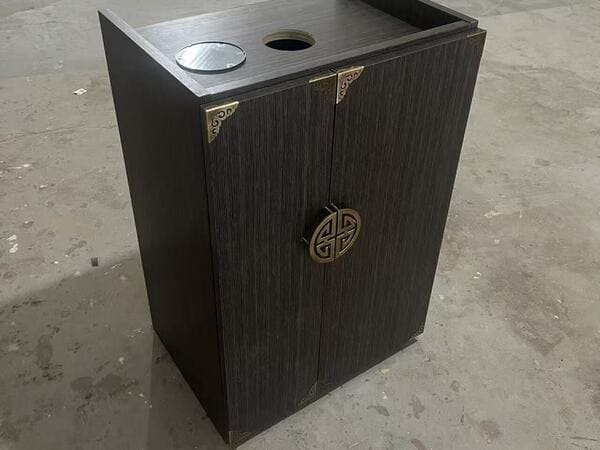
But if the design wants to keep the irregular variation of natural wood, and different doors are allowed to show natural differences in color and grain, natural wood veneer may be more suitable.
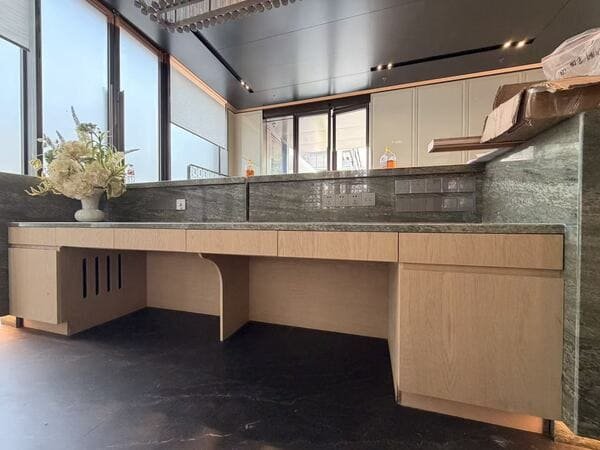
In our actual projects, we do not automatically change to engineered veneer just because the surface area is large. Some projects use both natural wood veneer and engineered veneer. Different materials are used in different areas based on the design requirements.
Using engineered veneer on a large surface also does not mean there will always be obvious grain repetition. The actual result still depends on the selected design and how it looks across the continuous visible surface.
So, for a large cabinet wall, the practical question is not:
Should we use engineered veneer because the area is large?
The question is:
Does this surface need more natural variation, or a more stable and easier-to-control overall appearance?
Does Engineered Veneer Have No Color Variation?
The color and grain of engineered veneer are usually easier to control than natural wood veneer, but this does not mean every sheet will be exactly the same.
In our actual batch production, we have seen visible color differences in engineered veneer.
When this happens, we do not first make a simple decision about whether the material can or cannot be used. We first check whether the panels will appear within the same continuous visible area.
For example, for a row of cabinet doors, a row of wood wall panels, or several visually connected panels, we try to place materials with similar colors together.
If some materials have a more obvious color difference, we do not place them together on the same continuous visible surface. Instead, we use cabinet corners, different elevations, or natural visual divisions in the space to separate them.
The reason is simple. Some color differences may not be very noticeable when the materials are viewed separately, but they become easier to see when two panels are placed directly next to each other.
We should also explain the limit of this method. At the moment, we mainly rely on visual inspection in production. We do not use a fixed viewing distance or a fixed color-difference value as a standard. So, this is our actual production method, not a universal inspection standard that can be applied to every project.
This is why, when we say engineered veneer is easier to control for consistency, we do not mean that engineered veneer has no color variation.
During batch production, we still need to check the actual materials and group and arrange them based on the continuous visible surfaces.
Can Different Production Batches Be Exactly the Same if the Product Code Is the Same?
The color and designed grain of engineered veneer are usually easier to repeat than natural wood veneer. However, “the design can be repeated” and “different production batches are exactly the same” are two different things.
Based on the public information we reviewed, different production batches may still have differences in color or grain.
The same product code helps us confirm the same design. But it does not mean a later order will have exactly the same final appearance.
For projects with higher requirements for color and continuous visual consistency, it is better to record the exact product name, product code, and production batch, and to keep the approved sample.
If a project is already expected to need future repairs or replacements, whether some material from the same batch should be kept can also be discussed during the project confirmation stage.
If a new production batch has to be purchased later, the actual material and final finished surface should be checked again. The result should not be judged only by the product code.
Is Engineered Veneer Always Cheaper Than Natural Wood Veneer?
In our actual purchasing, many common engineered veneers do cost less than natural wood veneer. However, this is only a common situation, not a fixed rule.
The price of engineered veneer can also depend on the color, grain design, brand, thickness, and order quantity. Some special patterns or high-end engineered veneer brands can cost more than some natural wood veneers.
Prices also vary greatly between different natural wood veneers.
So, when we quote a project, we do not simply assume that natural wood veneer is expensive and engineered veneer is cheap.
A more practical approach is to first confirm the specific material and then compare the related material cost and processing requirements.
What Should Be Confirmed Before Producing Natural Wood Veneer and Engineered Veneer Cabinetry?
At the project confirmation stage, the real problem is often not whether to choose natural wood veneer or engineered veneer. The problem is that the material requirement is not specific enough.
For example, if a drawing only says “White Oak Veneer,” it may represent two very different purchasing requirements depending on whether the veneer is natural or engineered.
The main points to confirm before production are also slightly different:
| Confirmation Item | Natural Wood Veneer | Engineered Veneer |
|---|---|---|
| Material type | Confirm natural wood veneer | Confirm reconstituted / engineered veneer |
| Actual wood species | Key point to confirm | Important when the project has species or traceability requirements |
| Grain and natural variation | Key point to confirm | Mainly confirm the selected visual design |
| Product / color code | Depends on the supplier | Usually very important |
| Veneer selection and layout | Directly affects continuous grain and color variation | Affects adjacent panels and the overall appearance |
| Material identification information | Record supplier, veneer batch, or flitch information based on the project | Record product code and production batch |
| Approved sample | Important | Important |
In addition, veneer thickness, substrate, grain direction, and final finish should be confirmed before production for both types of veneer.
For natural wood veneer, if the client requires natural white oak veneer, we also need to confirm the grain direction, veneer selection requirements, and the level of natural variation that can be accepted.
For engineered veneer, if the client has already specified a particular product, the supplier name, product code, color number, and physical sample are usually more reliable references than simply writing “White Oak Look” or “Walnut Look.”
For international projects, if forest certification or wood-origin requirements are also involved, the visual name and actual wood species should not be treated as the same information.
We have already discussed grain matching, veneer thickness, and sample approval in a previous wood veneer article, so we will not repeat those details here. The main point in this article is that although natural wood veneer and engineered veneer are both wood veneers, the key information that needs to be confirmed during purchasing is not exactly the same.
For us, material confirmation is not complete just because a wood species name appears on the drawing. The designer, buyer, and production team also need to have the same understanding of the actual material and the final appearance.
Final Notes
Natural wood veneer and engineered veneer are suitable for different applications. Natural wood veneer is more suitable for projects that need a specific actual wood species and natural variation, while engineered veneer makes it easier to control color and grain consistency.
For Horace Home, the more important point is to confirm the actual material and final appearance based on the client’s drawings, material codes, and samples before moving into production.
Based on information from ANSI/HPVA HP-1-2024 *American National Standard for Hardwood and Decorative Plywood*. ↩