
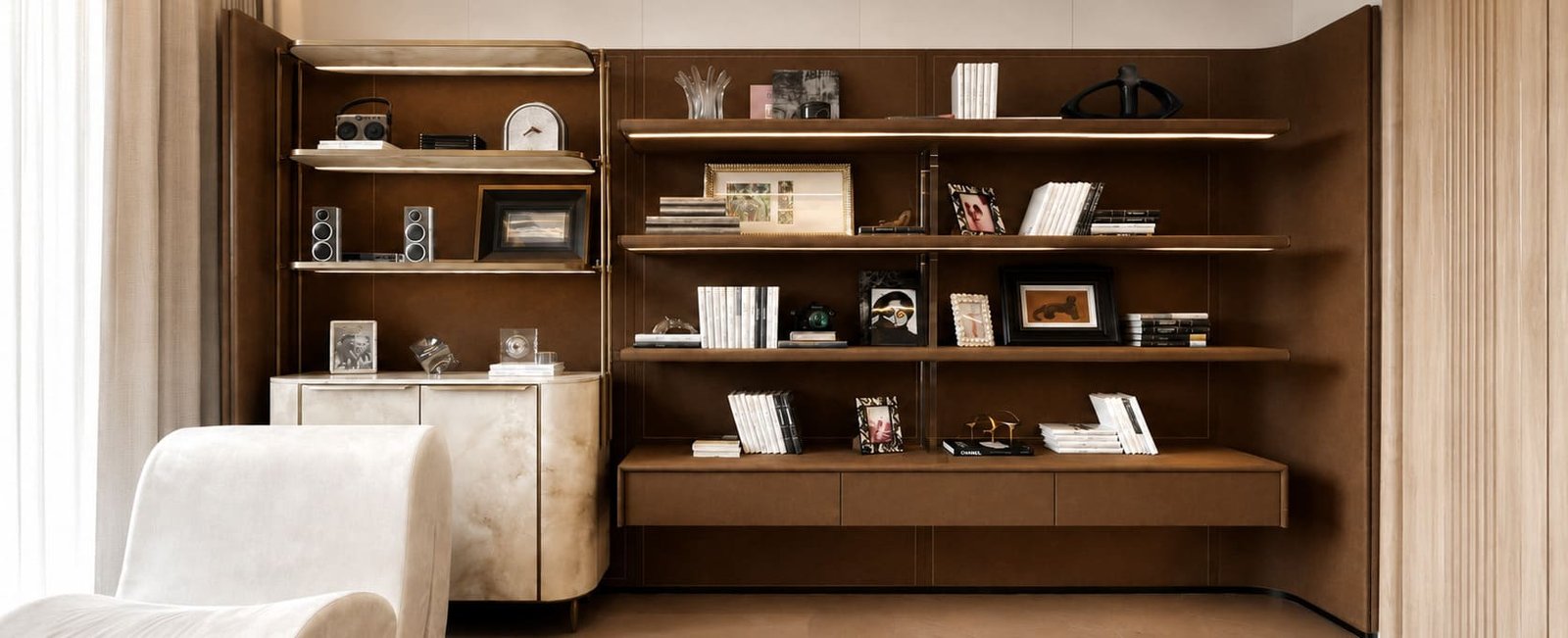
In custom cabinetry, many people see the term wood veneer cabinets and assume it means “solid wood cabinets.” In fact, veneer is only a thin layer of wood applied over the cabinet substrate. One of the main reasons for using natural wood veneer is to keep the natural grain and texture of real wood. Compared with a melamine finish, the grain comes from the wood itself.
Veneer still needs a substrate underneath, and the surface usually needs a coating after veneering. Different veneer types and thicknesses can also affect the later production process. So even when two products are both called wood veneer cabinets, the wood species is not the only thing that needs to be confirmed. The veneer type, substrate, thickness, application area, and surface finish can all affect the final result.
In this article, we will start with these basic points and look at how wood veneer cabinets are made and where they are commonly used.
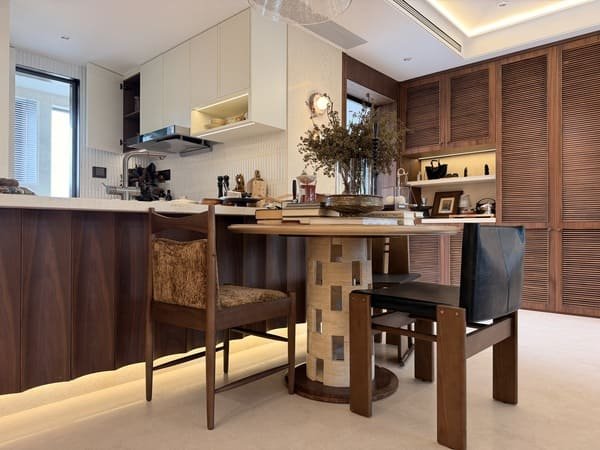
What Are Wood Veneer Cabinets?
Natural wood veneer is usually a thin layer of wood made by slicing or rotary cutting natural timber.1 It keeps the original color and grain of the wood. This means that even with the same wood species, the grain, color, and natural features can vary from one area to another.
In cabinetry, veneer is mainly used as a surface finish. It does not provide the main structural strength of the panel and needs to be bonded to a board substrate.
This is also the basic difference between wood veneer cabinets and solid wood cabinets. In solid wood panels, the wood itself forms the main structure, while wood veneer cabinets normally use a “substrate + veneer” structure.
Wood veneer is also different from wood-grain melamine. The wood grain on melamine mainly comes from decorative paper, so the color and pattern are easier to keep consistent in batch production. Natural veneer gets its grain from the wood itself, so natural variation is part of the material.
What Does a Wood Veneer Panel Usually Consist Of?
From a structural point of view, a wood veneer panel is usually more than just a “substrate + front veneer.” For a cabinet door, we also need to consider the adhesive layer, the back veneer, and the final surface coating.
Using one of our common wood veneer door structures as an example, the basic structure can be understood as follows:
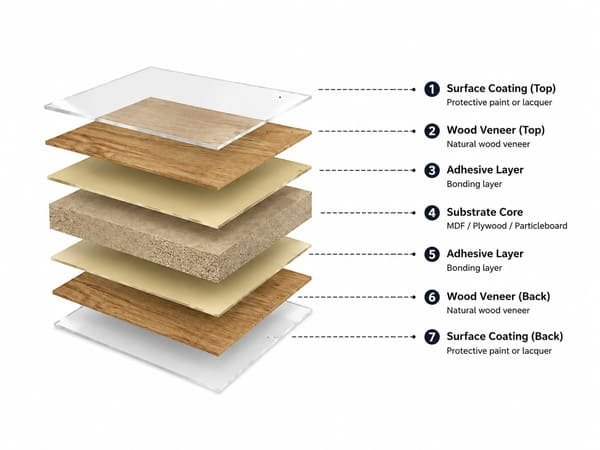
Surface coating — Wood Veneer — Adhesive layer — Substrate Core — Adhesive layer — Wood Veneer — Surface coating
In this structure, the substrate mainly determines the structure and stability of the panel. The veneer provides the natural wood grain. The adhesive bonds the veneer to the substrate. The final coating determines the color and sheen and provides most of the surface protection.
Veneer is not limited to one type of substrate. MDF, particleboard, and plywood can all be used as veneer substrates.1 For the wood veneer cabinets and doors we currently produce, we mainly use plywood. This is related to our current product structure, production system, and supply chain. It does not mean that other substrates cannot be used for wood veneer.
For the wood veneer doors we currently produce, veneer is applied to both sides. We also try to keep the veneer material, thickness, and grain direction consistent on both sides. This helps keep the appearance of both sides consistent and is also one of the ways we control the structural balance of the panel.
What Is the Difference Between Natural Veneer and Reconstituted Veneer?
Wood veneer used in cabinetry can include both natural veneer and reconstituted veneer. Both can create a wood-grain appearance, but they are different in grain variation, batch consistency, and typical applications.
| Comparison | Natural Veneer | Reconstituted Veneer |
|---|---|---|
| Grain | Keeps the natural grain of the wood, so each sheet can have some variation | Made by reorganizing and reprocessing wood material, allowing the grain and color to be controlled by design |
| Color variation | Natural color differences can still appear within the same species and batch | Batch color is usually easier to control |
| Natural features | Knots, color differences, and grain variation may appear | Less natural variation, with more focus on a consistent appearance |
| Batch consistency | Requires more attention to veneer selection and batch control | Relatively easier to control |
| Horace Home applications | In the projects we currently work on, it is used more often in home interiors that emphasize natural wood grain and texture | In the projects we currently work on, it is used more often for modern styles and projects that require higher batch consistency |
We have used natural veneers such as white oak, red oak, walnut, and figured maple. White oak is the one we use most often. In B2B projects, designers usually provide renderings and specify the veneer or wood species. If no specific veneer is given, we can provide options based on the rendering.
Natural veneer can also have different grades. Some of our current suppliers use A, AA, AAA, D, and S as their internal grading system. In this supplier grading system, A is a lower grade and S is the highest grade. Different grades can vary in color, grain, knots, overall consistency, and price.
However, this is not a globally standardized veneer grading system. Different suppliers may use different grading methods. For this reason, we do not judge veneer only by the grade name. We also confirm the actual veneer sample.
For projects that require higher consistency in color and grain, we sometimes purchase a batch of natural veneer sliced from the same log. This helps reduce differences between batches. However, even veneer from the same log will still have natural variation. This method can improve consistency, but it cannot make every sheet exactly the same.
What Are the Main Advantages and Limitations of Wood Veneer Cabinets?
From a practical point of view, wood veneer cabinets have several main advantages:
- The grain comes from real wood. Natural veneer keeps the original grain and color variation of the wood, so different panels will still have some natural differences.
- It works well with different shapes. Besides flat cabinet doors, veneer can also be used on curved panels, some irregular shapes, and decorative panels. Different shapes may require different veneering methods.
- It can be combined with other finishes. For example, a melamine cabinet body can be combined with wood veneer doors. This can help control the budget while keeping natural wood grain on the main visible areas.
In our actual projects, veneer is used most often on cabinet doors, followed by visible cabinet surfaces and some shaped panels.
Wood veneer also has some limitations that should be considered in advance:
- Natural veneer has color and grain variation. Large areas or batch projects require more attention to veneer selection, batches, and sample approval.
- Surface protection depends on the final coating. Areas with frequent friction, impact, or moisture exposure need to be evaluated based on the coating system and actual use conditions.
- The production process has more steps. Compared with melamine, wood veneer usually requires veneering, sanding, and coating. Irregular panels, special grain directions, or grain-matching requirements can also increase labor and material waste.
- Repair can be more difficult if the veneer itself is damaged. If only the coating is damaged, there may still be some room for repair. If the veneer itself has deep scratches, impact damage, or other serious damage, the panel may need to be remade.
For this reason, when we choose wood veneer, we also consider the application area, frequency of use, design effect, and future maintenance.
How Should Wood Veneer Thickness Be Considered?
Based on industry information, wood veneer is available in a wide range of thicknesses. In a broad sense, it can range from around 0.1 mm to several millimeters.1 However, decorative veneer used on cabinets and furniture is usually much thinner.
The thicknesses we currently use most often are 0.3 mm and 0.6 mm. We have also used 2 mm veneer for a customer’s special requirement.
| Veneer Thickness | Common Use at Horace Home | Practical Characteristics |
|---|---|---|
| 0.3 mm | Manual veneering for irregular and curved shapes | Thinner and easier to apply manually over more complex surfaces |
| 0.6 mm | Hot-press lamination for flat panels | In our actual use, the wood grain is usually more noticeable, and there is also more sanding allowance |
| 2 mm | Special customer requirement | We have used it before, but it is not one of our regular options |
Thicker veneer is not always better. In actual production, we choose the thickness based on the wood species, panel shape, and veneering method instead of judging veneer quality only by thickness.
Why Does Wood Veneer Still Need a Coating?
Wood veneer provides the natural grain and texture of wood, but it normally still needs a coating after veneering. The coating affects the final color and sheen, and it also provides most of the surface protection.
We have worked with clear coats, staining, open-pore and closed-pore finishes. The final sheen can also be adjusted according to the design, and matte finishes are common in our projects. Different coating methods can change the final color depth, grain appearance, and surface feel. This is why confirming only the wood species is not enough to define the final appearance.
Wood veneer itself is not the final protective layer against water, stains, or scratches. Actual performance also depends on the coating system, edge treatment, and the environment where the cabinet is used.
It is also important to understand that applying a coating does not make a wood veneer surface “waterproof.” A complete coating system can reduce direct exposure to moisture2 and stains, but areas with long-term moisture, frequent friction, or impact still need to be evaluated carefully before using wood veneer.
How Do We Confirm the Wood Veneer Finish Before Batch Production?
Before formal production, we usually make a complete wood veneer sample measuring 200 × 300 mm or 300 × 400 mm, instead of asking the customer to approve only a raw veneer sheet. The sample uses the actual substrate and actual veneer, and the final coating is also completed. The customer can then confirm:
- Wood species
- Grain
- Color
- Sheen
- Edge appearance
We prefer approval based on a physical sample because even the same wood species can have natural differences in color and grain. If the customer can only approve the sample through photos or videos, we explain in advance that lighting, cameras, and display devices may cause color differences.
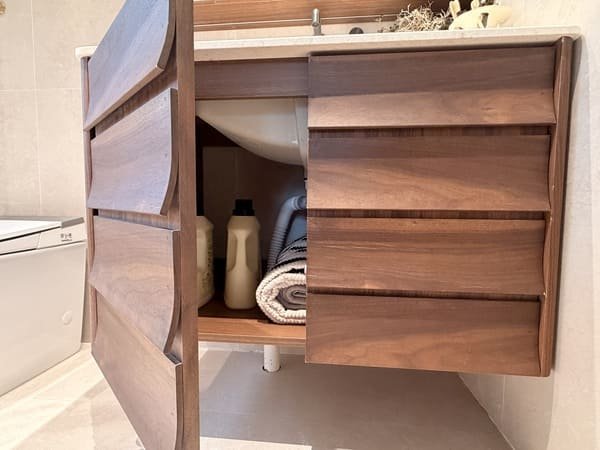
In one of our recently completed model home projects, the cabinet doors and some shaped visible panels used 0.6 mm walnut veneer + plywood + clear coat. Because some doors were taller and there were also exterior decorative panels, different areas used 18 mm, 22 mm, and 25 mm plywood substrates. The widest single cabinet door was about 500 mm. This project also moved into production only after the complete veneer sample was approved.
Final Notes
Wood veneer is suitable for cabinet designs that want to keep real wood grain and natural variation. However, this natural variation also means that it is not the best choice when every panel needs to look exactly the same. If a project gives more priority to batch consistency, wear resistance, or easier maintenance, melamine, PET, and other finishes can also be compared before making the final choice.
For projects that already have drawings, renderings, or clear veneer requirements, Horace Home can further confirm the veneer solution based on the panel size, shape, and target appearance, and then use a complete sample to confirm the final result before production.